Key takeaways
- Best for occasional DIY work: a 7-inch wet saw with a sliding table, roughly 14–20 inches of rip capacity, and a folding stand or compact footprint.
- Best for large-format tile: a 10-inch sliding-table wet saw with at least 24 inches of straight-rip capacity and approximately 18 inches of diagonal capacity.
- Best for portability: a lightweight 7-inch saw with a removable water tray and integrated carrying handle.
- Best for repeated renovation work: a contractor-grade saw with a rigid rail, adjustable fence, replaceable pump, and a blade designed for porcelain.
- Best for a small bathroom: a compact wet saw is usually enough unless the tile is 24 inches or longer; in that case, prioritize diagonal capacity over motor size.
Best Tile Saws for Accurate Cuts and Smooth Finishes
The best tile saws are chosen by tile size and cutting workload first: a compact 7-inch wet saw suits ordinary wall and floor tile, while a 10-inch sliding-table saw is the safer choice for large-format porcelain, long rips, and repeatable diagonal cuts.
Quick picks by project
- Best for occasional DIY work: a 7-inch wet saw with a sliding table, roughly 14–20 inches of rip capacity, and a folding stand or compact footprint.
- Best for large-format tile: a 10-inch sliding-table wet saw with at least 24 inches of straight-rip capacity and approximately 18 inches of diagonal capacity.
- Best for portability: a lightweight 7-inch saw with a removable water tray and integrated carrying handle.
- Best for repeated renovation work: a contractor-grade saw with a rigid rail, adjustable fence, replaceable pump, and a blade designed for porcelain.
- Best for a small bathroom: a compact wet saw is usually enough unless the tile is 24 inches or longer; in that case, prioritize diagonal capacity over motor size.
What separates the best tile saws?
A wet-cut saw cools the diamond blade and suppresses dust, but water alone does not guarantee an accurate finish. The table must stay flat, the fence must remain square, and the blade must track consistently through the tile. A flexible table or a rail with play can turn a theoretically precise saw into one that produces tapered cuts and chipped edges.
Our top picks


As an Amazon Associate we earn from qualifying purchases at no extra cost to you. Ratings are shown as listed on Amazon.
For most homeowners, the most useful specifications are blade diameter, maximum cutting length, diagonal capacity, table support, water containment, and the amount of setup required. Motor horsepower is helpful, but it is not a substitute for a straight guide and an appropriate porcelain blade.
| Tile-saw type | Typical blade | Useful capacity | Best fit | Main compromise |
|---|---|---|---|---|
| Compact wet saw | 7 inches | About 14–20-inch rips; roughly 10–13-inch diagonals | Backsplashes, bathrooms, small and medium floor tile | Limited support for 24-inch tile and long miters |
| Sliding-table contractor saw | 7 or 10 inches | About 20–24-inch rips; approximately 13–18-inch diagonals | General remodeling and porcelain floors | Heavier, wetter, and slower to store |
| Bridge-style large-format saw | 10 inches | Often 24–36-inch rips, depending on the model | Large-format tile, repeated straight cuts | Higher price and substantial setup space |
| Rail or plunge-style saw | 7–10 inches | Varies by rail length; useful for controlled plunge cuts | Cutouts, partial cuts, and long supported workpieces | Requires careful alignment and a stable support surface |
Head-to-head: 7-inch versus 10-inch wet saws
7-inch saws
A 7-inch wet saw is normally the better value for subway tile, ceramic wall tile, 12-inch floor tile, and many 12-by-24-inch installations where the cut direction does not exceed the machine’s capacity. Models such as the SKIL 3540-02 and the RYOBI WS750L represent this compact category.
Their advantages are lower cost, easier lifting, quicker setup, and smaller storage requirements. Many weigh approximately 35–60 pounds, although the stand and water tray can change the total. The limitation is not only maximum length. A narrow table gives less support at the beginning and end of a cut, so a long porcelain tile may flex or drift unless it is supported with an extension table.
10-inch saws
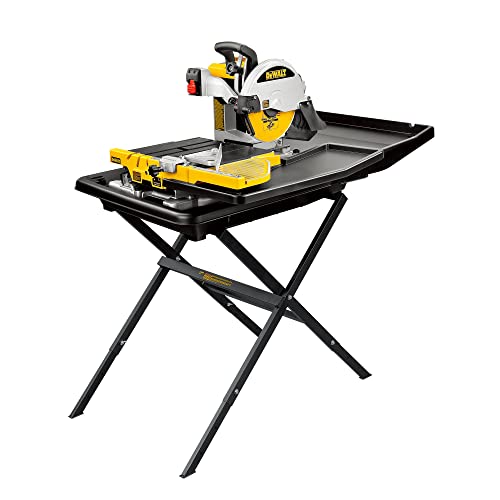
A 10-inch blade cuts deeper and is usually paired with a longer sliding table, stronger frame, and more capable fence. The DeWalt D24000 is a well-known example of a portable 10-inch wet saw, while larger bridge-style and contractor models are intended for heavier renovation schedules.
The larger format is worthwhile for 24-inch tile, thick porcelain, pavers, repeated miters, and diagonal cuts. The trade-off is physical: a saw weighing around 60–90 pounds may need two people to move safely, and a stand can add another bulky component. A larger blade also creates more splash and may take longer to clean.
Capacity matters more than the headline blade size
Check three measurements before buying. Rip capacity is the longest straight cut, but manufacturers may measure it with the tile positioned in a particular direction. Diagonal capacity determines whether a square tile can be cut corner to corner. Cutting depth matters for thick pavers, although most indoor ceramic and porcelain tile is well within the range of a 7-inch or 10-inch blade.
Measure the actual tile, not just the room. A 24-inch tile may require more than 24 inches of usable table travel because you need room to position the fence, keep both sides supported, and avoid pushing your hands close to the blade. For a 10-by-12-foot room using 24-inch square tile, plan a work area at least 8 feet long and 4 feet wide if possible. A temporary folding table can support the tile, but it must be level with the saw table and strong enough not to sag.
Water management and finish quality
Water containment is one of the most important differences between a pleasant cutting session and a muddy one. Look for a removable tray, splash guards, a pump that can be cleaned easily, and a drain or low corner that lets dirty water leave without tipping the entire machine.
- Use clean water for the first cuts and replace it when slurry becomes thick.
- Keep the pump inlet away from settled tile dust and sludge.
- Place a rubber mat or plastic sheet underneath; even good splash guards rarely keep every drop contained.
- Use a separate bucket for wastewater rather than sending cement-rich slurry into a household drain.
- Let the blade make the cut instead of forcing it. Excessive pressure causes heat, wandering, and edge chipping.
For porcelain, use a continuous-rim porcelain-rated diamond blade. A premium blade often improves the finish more than moving from a modest motor to a much larger one. If the visible edge will be exposed, allow a small amount of material for a polishing pad or rubbing stone rather than expecting the saw cut to be perfectly decorative.
Decision matrix for different homes and projects
| Your situation | Recommended specification | Why |
|---|---|---|
| Small apartment or shared garage | 7-inch saw, under about 50 pounds, removable tray | It can be carried through a standard doorway and stored on a shelf or utility rack. |
| Kids, pets, or finished indoor flooring | Enclosed splash tray, stable stand, low-spray water return | Less standing water reduces slip hazards and cleanup around the work area. |
| Renter doing a backsplash | Compact 7-inch saw with quick setup and modest water capacity | You avoid paying for a large machine that may be used only once. |
| Large-format porcelain renovation | 10-inch saw, at least 24-inch rip capacity, 18-inch diagonal capacity if possible | Long tiles need support, travel, and a rigid guide to prevent drifting cuts. |
| Back or shoulder limitations | Two-piece machine and stand, or a saw under about 60 pounds | Separate lifting tasks are easier than moving a single heavy assembly. |
Setup time, moving, and durability realities
A compact saw may be ready in 10–20 minutes once you have a water source, level support, blade, and electrical protection. A larger sliding-table saw commonly takes 20–40 minutes to assemble, align, fill, and test, especially when its stand is separate. Leave clearance around the machine: at least 24 inches on the operator side and enough space behind the saw for the tile to travel without striking a wall.
Before purchase, measure the storage route. A box may be narrow enough for a standard 30-inch doorway, yet the assembled saw can be awkward in a hallway or on stairs. Wheels help on a garage floor but do not eliminate the need to lift the machine over thresholds.
The parts most likely to wear are the diamond blade, pump, sliding-table rollers, fence hardware, and plastic water-tray fittings. A replaceable pump and commonly available blade sizes are valuable for long-term ownership. After every project, rinse the tray, clean the pump screen, dry metal rails, and store the blade where it cannot rust or become bent.
How much should you spend?
Basic compact wet saws usually cost about $100–$250. More capable 7-inch contractor saws generally fall around $250–$500, while portable 10-inch models commonly cost $500–$900. Heavy-duty bridge-style machines can exceed $1,000. Include the cost of a porcelain blade, stand, extension supports, electrical protection, and cleanup materials when comparing the total.
Final buying recommendation
Choose a 7-inch wet saw for occasional ceramic, backsplash, and standard floor-tile work when its rip and diagonal capacities comfortably exceed your largest cut. Choose a 10-inch sliding-table saw when you are installing large-format porcelain, cutting thick material, or need consistent repeatability across many rooms. Whichever size you select, prioritize a rigid table, accurate fence, effective water return, and a quality porcelain blade; those features have more influence on smooth, usable cuts than a large motor rating alone.