Key takeaways
- Dual quartz and PTC heating pairs radiant output with forced circulation.
- Manufacturer lists a 50 to 85 degrees Fahrenheit electronic thermostat.
- 12-hour timer and rolling cabinet support flexible supervised room use.
An infrared space heater may warm a home office or occupied living room, but a fan-assisted cabinet behaves differently from a slim wall model or decorative stove. These six picks vary in footprint, controls, and price. The U.S. Consumer Product Safety Commission’s 2026 guidance says to keep portable heaters three feet from combustibles, plug directly into a wall outlet, and turn them off while sleeping.
Quick Verdict: For most buyers who want a portable indoor supplemental heater, the Dr. Infrared Heater DR-968 is our Best Overall choice because its 1,500-watt quartz-and-PTC heating system combines thermostat control, a 12-hour timer, casters, and tip-over protection for $129.99 on the manufacturer’s October 2026 listing. Choose the Heat Storm Phoenix for a wall-mounted Wi-Fi installation instead. These are editorial selections based on manufacturer specifications and third-party reporting, not in-house testing; check current price and availability before ordering.
As an Amazon Associate we earn from qualifying purchases.
By DIY Ideas 4 Home Editorial Team
6 Infrared Space Heaters Reviewed
We compared manufacturer product pages, model-specific retailer specifications, and available manuals as of October 2026. Our priorities were heater output at 120 volts, documented operating controls, practical installation, physical size, and stated protection features rather than unqualified square-foot claims. The six listed prices range from $129.99 to $272.00, although promotions and different color configurations may alter checkout totals. The CPSC’s 2026 space-heater guidance applies regardless of which cabinet or wall style you choose.
| Product | Best For | Key Spec | Listed Price (as of October 2026) | Watch Out For |
|---|---|---|---|---|
| Dr. Infrared Heater DR-968 | Best Overall | 1,500 W; quartz plus PTC; 12-hour timer | $129.99 at Dr. Infrared Heater | Cabinet occupies 16 by 11 by 13 inches |
| Heat Storm A-1500-PHX-WIFI | Best for wall-mounted scheduling | 750/1,500 W; Wi-Fi; 19 by 4 by 16 in | $149.99 at Heat Storm | Wall-mount-only configuration and short cord |
| EdenPURE GEN2 | Best for carrying room to room | 1,500 W; infrared PTC; 12.5 lb | $224.00 at EdenPURE | Higher purchase cost; no published low-watt setting |
| Duraflame DFI-117-01-A23 | Best for fireplace appearance | 1,500 W; infrared; adjustable 3D flames | $219.99 at Home Depot | 23-inch-tall floor-standing stove takes space |
| EdenPURE Classic CopperPLUS | Best for granular heat controls | 1,000/1,500 W; 24 presets; 72-inch cord | $272.00 at EdenPURE | 24-pound cabinet and premium price |
| Heat Storm A-1500-SED-WI | Best for fan-only circulation | 750/1,500 W; Wi-Fi; fan-only mode | $159.99 at Heat Storm | Wall-mount-only setup; 36-inch cord |
Dr. Infrared Heater DR-968: Best Overall
Best For: Homeowners needing controllable supplemental heat in a lived-in room without permanently installing a wall unit.
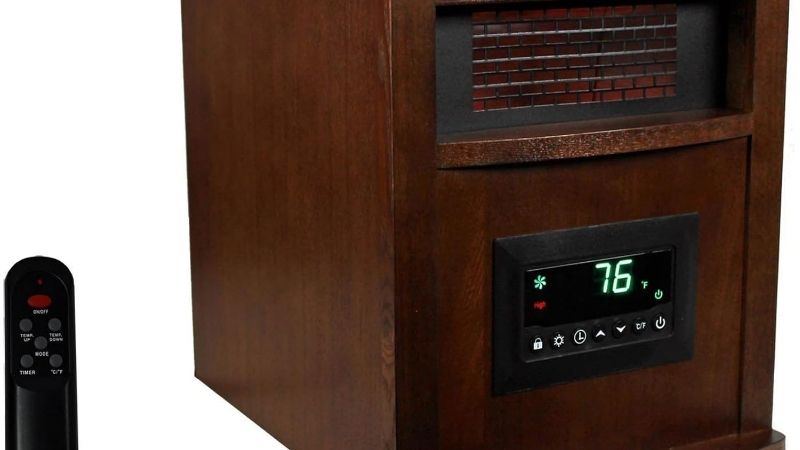
The DR-968 is the broadest fit here because it has wheels and a remote, yet also lets you set a target temperature rather than relying solely on an on/off switch. Its quartz infrared element supplies radiant warmth while a PTC element and quiet blower help move heated air. Compared with Heat Storm’s wall-only Phoenix, it can be repositioned when the occupied room changes; compared with the EdenPURE CopperPLUS, its listed purchase price is much lower. Its larger floor footprint is the concession.
Dr. Infrared Heater’s DR-968 product page lists a 1,500-watt output, a 39-decibel manufacturer noise claim, a digital thermostat spanning 50 to 85 degrees Fahrenheit, and a 12-hour shutoff timer. The company’s October 2026 price was $129.99. Bob Vila’s January and October 2026 hands-on reports also favor this model for controllability, although their reported cabinet weight differs from the current manufacturer’s listing. Use the exact revision’s specifications when comparing sellers instead of assuming every DR-968 listing has identical measurements.
The current DR-968 product page states the cabinet is 16 inches high, 11 inches wide, and 13 inches deep and weighs 20 pounds. Its rolling design helps move that weight on smooth flooring, but the casters do not make it a good option on stairs. Manufacturer documentation describes a tip-over shutoff and overheat protection, and the page represents the model as UL certified; check the label on the delivered unit. Leave airflow space around the grille and inspect the power cord before every heating season. The combination of movable parts and a fan also calls for occasional exterior dust removal according to the owner instructions.
Pros:
- Dual quartz and PTC heating pairs radiant output with forced circulation.
- Manufacturer lists a 50 to 85 degrees Fahrenheit electronic thermostat.
- 12-hour timer and rolling cabinet support flexible supervised room use.
Cons:
- Cabinet takes floor space that the wall-only Phoenix preserves.
- Moving a 20-pound unit over steps still requires lifting.
Who Should Buy It: Choose the DR-968 for everyday portable use; choose Heat Storm A-1500-PHX-WIFI when unobstructed wall placement matters more than portability.
Heat Storm Phoenix: Best for Wall Scheduling
Best For: Remote workers with little usable floor area who want a scheduled heater mounted on an appropriate wall.
For a desk tucked beside a chair, the Phoenix solves a placement problem before it solves a heating problem. It projects only four inches from the wall and offers phone-based scheduling, making it more practical than a rolling cabinet in a narrow workspace. Its thermostat, remote, and child-lock setting also make daily control approachable. The drawback is that the mounted heater must satisfy the installation and combustible-clearance rules in its manual; it cannot simply follow you into another room.
Heat Storm’s product page for the A-1500-PHX-WIFI lists 750-watt and 1,500-watt heat settings and an Eco mode that automatically switches power levels. It also specifies 120-volt input, a thermostat range of 40 to 99 degrees Fahrenheit, and 42 to 47 decibels of operating sound. The listed price is $149.99 in October 2026. Its Wi-Fi setup uses a Bluetooth-assisted connection and the Smart Life app; app control is convenient for scheduling, not evidence that a heater produces more heat from the same electrical input.
The Phoenix manufacturer page lists dimensions of 19 inches long, 4 inches deep, and 16 inches high, with an 8.45-pound weight and a three-foot power cord. Confirm the intended outlet can be reached directly without an extension lead, and use the supplied mounting template and hardware as directed. Wall-only installation differs from listings for older Phoenix units with removable feet. Manufacturer-stated tip-over or cool-touch claims should not replace safe mounting, and the 1-year warranty is less compelling if you need frequent relocation. Dust buildup near the grille deserves attention before winter use.
Pros:
- Four-inch cabinet depth frees floor space in tight offices.
- 750-watt mode provides a distinct lower-power choice from full output.
- Phone scheduling and a remote suit regularly occupied rooms.
Cons:
- Three-foot power cord sharply limits suitable wall and outlet positions.
- Requires a supported mounting surface rather than quick portable setup.
Who Should Buy It: Pick the A-1500-PHX-WIFI for scheduled office heating; choose EdenPURE GEN2 if you need to carry one appliance between rooms.
EdenPURE GEN2: Best for Room-to-Room Carrying
Best For: Residents who move a heater between occupied rooms and prefer a compact body with integrated carrying handles.
The GEN2 emphasizes a different kind of mobility from the DR-968. Instead of relying on casters and a tall cabinet, this unit places recessed handles on a shorter enclosure, so moving it between two rooms is more manageable when unplugged and cool. Its PTC-based infrared technology differs from an exposed glowing quartz tower, with a quiet mode and electronic controls for occupied spaces. Paying substantially more than the DR-968 buys this particular packaging and controls, not a meaningful increase above the 1,500-watt electrical ceiling.
EdenPURE’s GEN2 product page quotes $224.00 in October 2026, 1,500 watts at 12.5 amps, a digital thermostat, on/off timer, remote, and a washable filter. It also advertises a 5,000-BTU output and supplemental coverage of up to 1,000 square feet. Treat the advertised coverage as a maker estimate strongly influenced by insulation and existing central heat, not a promise that this small unit can heat every 1,000-square-foot floor plan. The page does not publish a distinct 750- or 1,000-watt setting, so shoppers specifically seeking reduced draw should prefer a model that documents one.
The GEN2 specifications give a weight of 12.5 pounds and dimensions of 9.75 inches high, 11.5 inches wide, and 15.25 inches deep. A 72-inch, 14-gauge power cord helps position it near a receptacle without using a power strip; EdenPURE’s product page also identifies a 1-year manufacturer’s warranty. A washable filter avoids a routine replacement-filter purchase, although owners still need to clean it according to instructions and keep the air intake clear. Verify the safety marks and shutdown functions on the exact supplied unit before making it part of a household heating plan.
Pros:
- 12.5-pound weight is easier to lift than large cabinet heaters.
- Six-foot cord provides more placement latitude around an outlet.
- Recessed handles and washable filter simplify routine household ownership.
Cons:
- $224 price is much higher than the manufacturer-priced DR-968.
- Current specifications do not document a separate reduced-watt setting.
Who Should Buy It: Buy the GEN2 for carrying between rooms; choose Dr. Infrared Heater DR-968 if casters and a lower initial cost better match your home.
Duraflame DFI-117-01-A23: Best for Fireplace Style
Best For: Buyers who want a visible flame display and a freestanding infrared heater in one living-room appliance.
Most portable heaters are appliances you want to hide. The DFI-117-01-A23 is designed to be seen: it resembles a small stove and makes its decorative flames a usable feature even when the heating element is off. That makes it an alternative to a separate electric fireplace purchase, not necessarily the best tool for a crowded desk. Its controls allow visitors to enjoy an ambient flame effect without running a 1,500-watt heater when warmth is unnecessary.
Home Depot’s product listing for model DFI-117-01-A23 identifies a 1,500-watt, 120-volt infrared stove with 5,200 BTU per hour of nominal heat output, an adjustable digital thermostat, and a remote. Five flame colors, brightness levels, and flame-speed settings are disclosed on the same listing, alongside a price of $219.99 as of October 2026. Twin Star Home manufactures and distributes Duraflame-branded electric stove heaters under license. The retailer’s 1,000-square-foot coverage statement is a supplemental-heating marketing claim rather than a substitute for room heat-load calculations.
Home Depot’s model-specific dimensions show the DFI-117-01-A23 at 23 inches high, 19.5 inches wide, and 10.6 inches deep, with a six-foot cord stated in the product-specialist Q&A. It is a floor-standing piece with legs, which need correct attachment and a stable, level surface. The retailer lists a 1-year manufacturer warranty and represents the product as UL listed, but shoppers should confirm the actual label. Unlike a unit with an explicitly documented tip-over shutoff, the listing reviewed here does not establish that feature; do not assume a decorative metal stove is safe to leave operating unattended.
Pros:
- Five flame-color choices offer ambience independently of the heater function.
- Six-foot reported power cord aids placement beside a living-room wall.
- Separate remote and thermostat reduce visits to its stove controls.
Cons:
- Freestanding 23-inch body cannot match a slim wall-mounted unit.
- Current listing does not clearly document a tip-over protection mechanism.
Who Should Buy It: Choose this Duraflame for visible fireplace ambience; choose Heat Storm A-1500-PHX-WIFI when clear floor area outweighs decorative appeal.
EdenPURE CopperPLUS: Best for Fine Heat Control
Best For: Households prioritizing many temperature presets and two stated heating-power levels over a low upfront price.
The CopperPLUS offers more adjustment than shoppers who only need a low/high switch will probably use. Its 24 temperature presets, 1,000-watt low mode, and remote make sense in an occupied room where changing desired warmth frequently matters. This is not a reason to expect extra heat from the same electrical input. Its distinctive value is the detailed control interface and cabinet-style circulation, balanced against the highest price and one of the heaviest cases in this comparison.
EdenPURE’s product page for the Classic CopperPLUS gives a listed October 2026 selling price of $272.00 and specifies 1,500 watts on high and 1,000 watts on low. The manufacturer describes a copper PTC heating element, 24 settings across 40 to 90 degrees Fahrenheit, dual high-limit sensors, and a tip-over sensor. The product literature also says the grille is designed to be touch-safe; that claim must not be interpreted as permission to disregard three-foot clearance guidance. EdenPURE’s alternative 1,000-square-foot coverage description remains dependent on room conditions and supplemental HVAC operation.
The manufacturer records a 24-pound cabinet measuring 16.75 inches high, 13 inches wide, and 16.5 inches deep. A 72-inch, 14-gauge cord, 120-volt operation, and reusable filter make the day-to-day setup understandable. The product page states cETL approval, but purchasers should inspect the delivered unit’s safety mark and read the current manual. EdenPURE’s warranty information advertises a one-year warranty, while replacement elements and fans are not items a typical buyer should assume are inexpensive or owner-serviceable. That matters when justifying a premium purchase price over a simpler portable heater.
Pros:
- 24 manufacturer-stated presets offer unusually granular temperature selection.
- Documented 1,000-watt low setting reduces draw versus full output.
- Six-foot cord and washable filter help with regular operation.
Cons:
- At $272, it costs more than the other five picks.
- 24-pound body needs more effort to reposition than the GEN2.
Who Should Buy It: Choose CopperPLUS for temperature-control flexibility; buy EdenPURE GEN2 if a light, easily lifted heater is more important.
Heat Storm Sedona: Best for Fan-Only Circulation
Best For: Dedicated home offices needing a permanent infrared wall unit that also circulates air in warmer months.
The Sedona and Phoenix have similar infrared output and phone scheduling, but the Sedona has a separate fan-only mode. That feature gives the mounted appliance something to do after heating season, although it will not replace a cooling air conditioner or full-size circulating fan. Its shorter body also fits some wall arrangements differently from the Phoenix. The comparison hinges on whether fan-only operation is useful, because buying two nearly identical wall heaters for their nominal output would otherwise make little sense.
Heat Storm’s A-1500-SED-WI product page lists $159.99 as the October 2026 price, alongside 750- and 1,500-watt heating modes, a claimed 42 to 47 decibel noise range, 120-volt input, and a digital thermostat. The product description specifies Wi-Fi scheduling through the Smart Life app, an included remote, and a fan-only option for air circulation. Manufacturer-stated 150-square-foot primary and 750-square-foot supplemental coverage figures reflect different assumptions and should never be interpreted as interchangeable.
The Sedona is listed at 19 inches long, 4.75 inches deep, and 13.25 inches high and weighs 7.72 pounds. Its manufacturer-specified 36-inch cord may be the limiting dimension in an existing office: a wall outlet must be accessible without an extension cord. The Sedona is wall-mount-only, and the box includes mounting hardware and a remote. Before drilling, check the manual for suitable wall construction, exact mounting height, and clearances. Heat Storm’s stated one-year warranty and routine fan intake cleaning also matter when considering ownership beyond the first cold season.
Pros:
- Fan-only mode serves a different use after heating season.
- 7.72-pound mounted cabinet avoids taking up floor space.
- Wi-Fi scheduling and documented 750-watt setting support timed use.
Cons:
- Thirty-six-inch cord can force an inconvenient wall placement.
- Fan-only airflow should not be mistaken for active cooling.
Who Should Buy It: Pick the Sedona if summer fan circulation is genuinely useful; choose Dr. Infrared Heater DR-968 for mobile heating without wall installation.
How to Choose an Infrared Space Heater
Choosing an indoor heater starts with the heating job and a safe outlet, not a manufacturer’s maximum room-size graphic. Portable infrared designs range from radiant-focused units to fan-assisted quartz and PTC combinations, and the extra technology does not repeal the electrical limits of a standard household circuit. The following four checks determine whether the appliance will be useful after its novelty wears off.
Match Wattage to the Room’s Actual Heating Job
All six heaters here offer a 1,500-watt maximum setting, so none can legitimately promise a dramatic increase in total heat solely because it is labeled infrared. The U.S. Department of Energy’s residential heating materials explain that electric resistance systems turn nearly all of the electricity they use into heat. That is why energy savings come mainly from zone heating, shorter operating periods, and thermostat cycling, not from a branded quartz tube allegedly multiplying energy.
At a 120-volt supply, a 1,500-watt load draws approximately 12.5 amps, leaving limited room for other heavy appliances on a typical 15-amp circuit. The Phoenix and Sedona offer 750-watt operation; CopperPLUS specifies a 1,000-watt low mode. Compare those documented settings if the intention is to reduce power draw, remembering that a smaller setting may require longer runtime in a chilly room. Manufacturer coverage figures as high as 1,000 square feet refer to favorable supplemental conditions, not a primary-heating guarantee.
Prioritize Safety Documentation Over Surface Claims
The CPSC’s 2026 winter safety advice says to maintain three feet between space heaters and flammable household items and to avoid extension cords or power strips. A tip-over switch and overheat shutoff add useful layers of protection, but they do not turn a portable heater into a device that should run while everyone sleeps or while the room is unattended. DR-968 documentation discusses both shutdown functions, while EdenPURE lists dual high-limit and tip-over sensors on the CopperPLUS. For a unit with undocumented protections, verify its current label, manufacturer manual, and product recall status before buying.
UL and ETL marks apply to specific models and manufacturers’ declared configurations, not to the infrared category as a whole. The manufacturer pages for DR-968 and CopperPLUS state their respective safety marks, and Home Depot lists UL for the Duraflame model. Read the actual certification marking on the heater, avoid any cracked or hot plug, and stop using a unit with signs of wiring damage. A 1,500-watt device does not become safe on an overloaded outlet merely because a seller calls it energy efficient.
Measure the Footprint, Power Cord, and Mounting Wall
A four-inch-deep Phoenix changes how a narrow office can be furnished, but its three-foot cord and fixed wall location may rule out a convenient mounting spot. The Sedona also uses a short cord yet its lower 13.25-inch height can suit a different wall opening. Both models call for careful attention to manufacturer’s clearance instructions, drywall anchors or studs as required, and a nearby wall receptacle. A wall heater should never be mounted behind curtains or beneath items that violate its manual’s spacing instructions.
For a rolling or carry-style heater, check where it will sit when people cross the room and whether the cord could become a trip hazard. The 20-pound maker-listed DR-968 is easier to roll than lift, while the 12.5-pound GEN2 is easier to carry across a doorway. Duraflame’s 19.5-inch width and 23-inch height give it a furnishing-like presence. Neither infrared technology nor a touch-safe marketing description makes clearance from blankets and upholstery optional.
Consider Controls, Operating Noise, and Long-Term Cost
The right thermostat can be more useful than an elaborate heat-element name. A timed home office might benefit from Phoenix Wi-Fi scheduling, whereas occasional evening use may only require the DR-968 remote and 12-hour timer. If air movement is irritating, compare published blower noise cautiously: Dr. Infrared lists 39 decibels for its cabinet, while Heat Storm specifies 42 to 47 decibels for its wall units. Those manufacturer figures may not use identical testing distances, so they are not a laboratory head-to-head ranking.
Consider what ownership requires after the purchase. The two EdenPURE models disclose washable filters, while Duraflame provides decorative effects that may make the heater worth using without heat. A wall unit may involve installation effort, and a heavy cabinet needs a stable floor location. Warranty terms, the availability of replacement parts, and the cost of electricity in your utility territory often matter more than a promotional efficiency slogan. Compare exact model numbers, accessories, and posted prices before checking out.
Frequently Asked Questions
Infrared heating raises practical questions that product descriptions often blur, especially when radiant warmth, fan-driven heat, and decorative electric fireplaces appear in the same shopping results. These distinctions help set realistic expectations for a home installation.
Does infrared heat warm people or the whole room?
Infrared radiation warms people and objects in its path, while many indoor appliances also use fans to circulate warmed air. The DR-968 combines quartz infrared output with a PTC system, so its comfort is not restricted to a narrow line of sight. A wall-mounted Phoenix still provides 1,500 watts at full output; it is a supplemental room heater rather than a substitute for central heating across a large house.
Will a 1,500-watt heater work in a 15-amp outlet?
Typically, a properly functioning 120-volt, 15-amp circuit can supply a 1,500-watt plug-in heater, but the appliance already draws approximately 12.5 amps. Other devices on the same branch circuit, circuit condition, and the manufacturer’s electrical instructions matter. Do not use a power strip or extension cord; if the receptacle, plug, or wiring becomes unusually hot, stop using it and have a qualified electrician evaluate the problem.
Can an infrared heater run overnight unattended?
No. The CPSC’s 2026 guidance says to turn portable space heaters off while sleeping. Built-in timers, remotes, touch-safe housings, tip-over switches, and app controls do not replace direct supervision or proper clearance. For overnight comfort, an appropriate fixed heating system controlled by a thermostat is usually a better plan than relying on a portable resistance heater while occupants sleep.
Do infrared heaters add moisture or fix dry air?
No. The infrared heaters in this comparison do not add water vapor to indoor air. Sellers sometimes say infrared heating does not dry out air, but heating a room can still reduce relative humidity without adding or removing moisture. A separate humidifier may be appropriate when indoor humidity is genuinely low, and excess moisture can cause condensation and mold. Check humidity with a hygrometer rather than using heater marketing as a substitute for measurement.
Final Thoughts
The Dr. Infrared Heater DR-968 remains our Best Overall infrared space heater for a buyer who needs flexible room placement, a real thermostat, and documented shutoff features at a comparatively accessible manufacturer-listed price. Before choosing it, identify one unobstructed floor location near an outlet and check that your existing circuit can support its 12.5-amp full-load demand. If that location does not exist but a suitable mounting wall does, the Heat Storm A-1500-PHX-WIFI is the more practical purchase. Confirm the exact model, price, and safety marking at checkout rather than buying solely from a claimed square-foot rating.