Key takeaways
- Best overall: Dramm ColorStorm, a recycled-rubber hose made in the United States with a thick wall and nickel-plated brass couplings (published lengths include 25 and 50 feet).
- Best for long runs: Water Right 700 Series, a 100-foot hose that leads several 2026 lists.
- Best budget for straight rows: Gilmour Flat Soaker (also sold as the Flat Weeper), available in lengths from 25 feet up to 75 feet.
- Best complete kit: Flexon WS100KITCN, a 100-foot kit with fittings and layout guides and a seven-year warranty according to one guide.
- Best 100-foot value: RAINPOINT 100-foot soaker hose.
- Best combo hose: Swan Element Sprinkler+ Soaker Hose, a 50-foot hose that can sprinkle or soak.
The Dramm ColorStorm is the best soaker hose for most garden beds, the Water Right 700 Series is the strongest pick for long runs, the Gilmour Flat Soaker is the budget option for straight rows, and the Flexon WS100KITCN is the best kit if you want a complete layout in one box. Whichever you choose, keep a single run under about 100 feet and add a pressure regulator, because soaker hoses weep best at very low pressure.
A soaker hose is a porous hose that seeps water along its length straight into the soil. It uses far less water than an overhead sprinkler, keeps leaves dry, and suits vegetable rows, shrub borders and raised beds. This guide compares recycled-rubber and porous-vinyl designs, maximum run length, pressure needs and coverage per 25 feet. It is a research-based comparison built from manufacturer details and several 2026 buying guides; where a figure could not be confirmed, we describe the class instead.
Our top picks


As an Amazon Associate we earn from qualifying purchases at no extra cost to you.
Quick picks
- Best overall: Dramm ColorStorm, a recycled-rubber hose made in the United States with a thick wall and nickel-plated brass couplings (published lengths include 25 and 50 feet).
- Best for long runs: Water Right 700 Series, a 100-foot hose that leads several 2026 lists.
- Best budget for straight rows: Gilmour Flat Soaker (also sold as the Flat Weeper), available in lengths from 25 feet up to 75 feet.
- Best complete kit: Flexon WS100KITCN, a 100-foot kit with fittings and layout guides and a seven-year warranty according to one guide.
- Best 100-foot value: RAINPOINT 100-foot soaker hose.
- Best combo hose: Swan Element Sprinkler+ Soaker Hose, a 50-foot hose that can sprinkle or soak.
How we chose
This is a research-based selection. We read manufacturer specifications and compared them with how several independent 2026 guides describe each hose, then kept models that are still sold and that serve a distinct bed layout. We did not rely on a single ranking. When sources disagree on length or warranty, we say so, and we describe unverified details by class.
The main criteria, in priority order:
- Even seepage along the run. A hose that drips only near the faucet end wastes the far end of the bed.
- Material. Recycled rubber is thick and tends to resist sun and kinking; porous vinyl or flat-weeper hoses are lighter and cheaper but wear sooner.
- Maximum useful length. Pressure falls along the hose, so output is uneven on long runs.
- Fittings. Solid brass or nickel-plated brass couplings last longer than plastic ones.
- Flexibility for curves. A stiff hose is hard to lay around a round bed.
Spec comparison
| Model | Material | Published length | Couplings | Layout fit | Notes |
|---|---|---|---|---|---|
| Dramm ColorStorm | Recycled rubber | 25 and 50 ft | Nickel-plated brass | Curves and borders | Thick wall, made in USA |
| Water Right 700 Series | Recycled-rubber class | 100 ft | Brass-class fittings | Long beds | Leads several 2026 lists |
| Gilmour Flat Soaker | Flat porous vinyl | 25, 50 and 75 ft | Standard | Straight rows | Budget, long lengths |
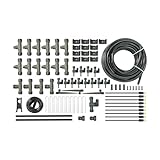
| Flexon WS100KITCN | Porous hose with kit | 100 ft kit | Kit fittings | Rows, curves, rings | 20-piece kit, layout guides |
| RAINPOINT 100 ft soaker | Porous hose | 100 ft | Standard | Large gardens | Value 100 ft option |
| Swan Element Sprinkler+ Soaker | Dual-mode hose | 50 ft | Standard | Mixed beds | Sprinkle or soak |
Lengths and warranty terms are as reported by 2026 buying guides and can differ between retailers and pack sizes, so confirm before you buy.
Group 1: Recycled rubber (durable, flexible, best for beds you will keep)
1. Dramm ColorStorm
Spec line: Recycled rubber · thick wall · nickel-plated brass couplings · published lengths 25 and 50 ft · made in USA
Best for: permanent beds, shrub borders and vegetable plots where the hose stays in place for several seasons. BestReviews named it its top soaker hose.
Skip if: you need a 100-foot continuous run or a very low-cost hose.
- Pros: Thick wall, sun-resistant, bends well around beds, strong couplings.
- Cons: Shorter published lengths, heavier than vinyl, higher cost than flat weepers.
2. Water Right 700 Series
Spec line: 100-foot length · recycled-rubber-class construction · brass-class fittings
Best for: long beds and large gardens where you want a single continuous run. It topped Ezvid’s October 2026 update.
Skip if: your beds are small. A hose this long is awkward to coil and store.
- Pros: Long run, durable class, strong ranking across guides.
- Cons: Output at the far end drops without a regulator; large and heavy.
Group 2: Porous vinyl and flat weepers (low cost, light, straight rows)
3. Gilmour Flat Soaker
Spec line: Flat porous vinyl · available in 25, 50 and 75 ft · standard couplings
Best for: straight vegetable rows and beds along a house wall. NBC Select picked the 75-foot version as its best soaker hose.
Skip if: you need to curve it tightly; flat hoses twist and kink.
- Pros: Low cost, light, extra-long lengths available.
- Cons: Less durable than rubber, and a flat hose can twist so the weep holes face the wrong way.
4. RAINPOINT 100-foot soaker hose
Spec line: Porous hose · 100 ft · standard couplings
Best for: large gardens where cost per foot matters.
Skip if: you want a rubber hose built to stay out through many winters.
- Pros: Full 100 feet, good value.
- Cons: Same pressure-drop limits as any 100-foot run; durability class is lower than rubber.
Group 3: Kits and combo hoses
5. Flexon WS100KITCN
Spec line: 100-foot hose · 20-piece kit with fittings · layout guides for rows, curves and rings · seven-year warranty reported
Best for: first-time buyers who want parts included to build a custom layout. BestReviews called it the best bang for the buck.
Skip if: you already own connectors and only need a single hose.
- Pros: Everything needed in the box, layout guides, long warranty.
- Cons: More parts to assemble, and kit fittings can be plastic.
6. Swan Element Sprinkler+ Soaker Hose
Spec line: Dual-mode · 50 ft · sprinkle or soak
Best for: mixed gardens where you sometimes want a mist for seedlings and sometimes a slow soak.
Skip if: you want a dedicated, even soak. A dual-mode hose is less targeted.
- Pros: Flexible use, 50-foot length.
- Cons: Less precise than a dedicated soaker, and sprinkle mode wets leaves.
Decision matrix: match the hose to the bed
| Bed | Layout | Best pick |
|---|---|---|
| Permanent shrub border | Curves, stays in place | Dramm ColorStorm |
| Long vegetable plot | Many parallel rows | Water Right 700 Series or Flexon kit |
| Single straight row | One line against a wall | Gilmour Flat Soaker |
| Large garden on a budget | Wide, many beds | RAINPOINT 100 ft |
| New seedlings and established plants | Mixed | Swan Element Sprinkler+ Soaker |
| First install, no connectors | Custom layout | Flexon WS100KITCN |
Worked example: spacing and run length for a 4-by-20-foot raised bed
Soaker hoses wet a band of soil. Many gardeners work from a seep width of roughly 12 to 24 inches either side of the hose, depending on soil type: wider in clay, narrower in sand. Use 8 inches of lateral spread each side as a cautious figure for sandy soil.
- Bed width: 4 feet is 48 inches. With about 8 inches lateral spread per side (16 inches total per run), you need 48 / 16 = 3 runs for sandy soil. In clay with 12 inches each side (24 inches per run), you need 2 runs.
- Hose length per run: the bed is 20 feet long, so each run is about 20 feet plus a foot or so for turns.
- Total hose needed: 3 runs x 21 feet is about 63 feet for sandy soil. Two runs x 21 feet is about 42 feet for clay. Serpentine the hose in a single continuous line to avoid joining pieces.
- Check pressure: 63 feet is under the 100-foot ceiling, so one inlet works. If the total were over 100 feet, split it into two zones with a Y connector.
- Run time: a common starting point is 30 to 60 minutes at low flow, then dig a few inches to see how deep the moisture went and adjust.
Use a trowel to check, not guesswork. Moisture should reach 6 to 8 inches for most vegetables.
Buying criteria with thresholds
Maximum run length
Keep a single soaker run to about 100 feet at the most, and ideally 50 to 75 feet. Past that, pressure falls along the hose, so the end nearest the faucet weeps heavily and the far end hardly at all. For bigger gardens, use a plain hose as a feeder and attach several shorter soakers.
Pressure regulator
Soaker hoses are designed for low pressure, typically in the range of about 10 to 25 psi. Household pressure of 40 to 60 psi can make joints leak or even burst a seep wall, so fit a low-pressure regulator at the faucet, and open the valve only partway.
Material
Recycled rubber is thicker and holds up in sun and cold. Porous vinyl is lighter and cheaper, and it suits seasonal vegetable rows. Flat hoses lie neatly but twist easily.
Coverage per 25 feet
Expect each 25 feet to wet a strip about 2 feet wide, giving roughly 50 square feet of bed. In practice this varies with soil texture, so a 50-foot hose covers about 100 square feet of bed.
Fittings
Brass or nickel-plated brass couplings seal better and survive repeated tightening. Use rubber washers, hand-tighten, and replace washers each spring.
Installation and care
- Lay it on level ground. Water seeps downhill, so slope causes uneven soaking.
- Bury or mulch it. A 2-inch layer of mulch holds moisture and shades the hose from UV.
- Place the weep holes facing down or sideways where the hose has a seam, so water goes into the soil.
- Flush before use. Run water through with the end open for a few seconds to clear sediment.
- Prevent clogging. Hard water leaves mineral deposits; use a filter at the faucet if you have well water.
- Drain and coil for winter. Trapped water freezes and splits porous walls.
- Do not run a soaker hose under black plastic in hot weather. It heats up and can scorch roots near the surface.
Frequently asked questions
What is the best soaker hose for a vegetable garden?
The Dramm ColorStorm is a top choice for permanent beds, while the Water Right 700 Series suits long vegetable plots. Both resist sun damage better than flat vinyl.
For one straight row, the Gilmour Flat Soaker is the low-cost option.
How long can a soaker hose be before pressure drops?
Aim for 100 feet at the most, and ideally 50 to 75 feet per run. Beyond that, the far end waters much less than the near end.
For larger gardens, run a plain hose to the bed and attach several shorter soakers.
Do I need a pressure regulator for a soaker hose?
Yes, in most homes. Household pressure is higher than soaker hoses are designed for, and a regulator prevents leaks and bursts.
Check the instructions for the hose you buy, and open the faucet only partway.
How long should I run a soaker hose?
Start with 30 to 60 minutes, then dig a few inches down to see how far the moisture traveled. Adjust from there.
Clay soil needs shorter, less frequent runs than sand, which drains quickly.
Is a rubber or vinyl soaker hose better?
Recycled rubber is usually more durable and flexible, while vinyl is lighter and cheaper. For beds that stay in place for years, rubber is the better value.
For seasonal vegetable rows that you replace every year, a flat vinyl hose may be enough.
Can I bury a soaker hose?
Yes, under 1 to 2 inches of soil or mulch. This reduces evaporation and protects it from sun.
Do not bury it deeper, because you will not be able to check for clogs or leaks easily.
Why is my soaker hose leaking at the connection?
The usual causes are a missing washer, a cross-threaded fitting or too much pressure. Replace the washer and add a regulator.
If the seep wall itself is splitting, the hose has probably been run at too high a pressure and should be replaced.
How many feet of soaker hose do I need per bed?
Divide the bed width by the seep width (often 16 to 24 inches per run), then multiply the number of runs by the bed length. Add a foot per turn.
A 4-by-20-foot bed typically needs about 40 to 65 feet depending on soil type.
Common mistakes to avoid
- Running the hose at full faucet pressure. This is the most frequent cause of blown fittings and uneven seepage. Use a regulator and open the valve a little at a time.
- Joining several 50-foot lengths end to end. Each joint adds resistance, so the last length barely weeps. Feed each length from a plain hose through a manifold instead.
- Watering on a slope without contour. Lay the hose along the contour line rather than down the hill so water soaks in rather than running to the bottom.
- Skipping mulch. Bare soil above a soaker hose dries from the surface, so mulch usually halves how long you need to run it.
- Forgetting roots. Place the hose within a hand-width of young plants, and move it outward as shrubs and tomatoes grow, because roots follow the water.
Final recommendation
Buy the Dramm ColorStorm for beds you plan to keep, the Water Right 700 Series for long runs, and the Flexon WS100KITCN if you want a complete kit. Choose the Gilmour Flat Soaker for straight rows on a budget. Whatever you pick, fit a low-pressure regulator and keep each run under about 100 feet.