Anyone who has pulled a table saw out of a garage in March and found orange freckles blooming across the cast-iron top knows the real problem isn’t rain, it’s the air itself. Garages sit half-outside: uninsulated slabs sweat, single-skin doors radiate cold, and every damp car pulled inside dumps another quart of moisture onto the floor. Once relative humidity parks above 60%, tool steel oxidizes, plywood offcuts cup, drywall screws bleed rust rings, and stored cardboard turns soft. The frustrating part is that most people buy a dehumidifier sized for a bedroom, watch it fill a tiny bucket twice a day, and conclude the machine is broken when it’s simply outmatched.
This guide approaches the problem the way you’d approach any shop upgrade: figure out the actual load, then buy the tool that handles it without babysitting. Below you’ll find units that cover 4,500 to 7,000 square feet of drying capacity, all with hose ports or onboard pumps so you can walk away and forget about them. I’ve flagged which models tolerate a cold, unconditioned bay, which run quietly enough that you can still hear a router bit chatter, and which ones earn their Energy Star badge in ongoing electricity costs.
Our top picks


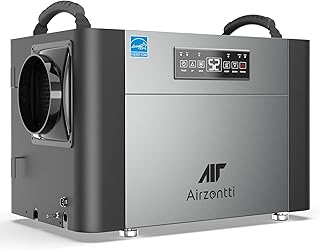

As an Amazon Associate we earn from qualifying purchases at no extra cost to you.
🛒 Best Price Today on Amazon
Prime members get fast, free shipping on everything above, plus member-only deals. New members get a 30-day free trial — cancel anytime.
How to Choose a Garage Dehumidifier (2026)
- Oversize the pint rating on purpose: A garage leaks air constantly through door seals and the gap under the slab, so treat manufacturer square-footage claims as best-case. If your bay is 500 sq ft, shop the 4,500 sq ft class or larger and let the unit cycle off instead of running flat out.
- Auto-defrost is mandatory, not a bonus: Compressor coils frost over below roughly 60°F, and an unheated garage hits that for months. Without a defrost cycle the machine ices solid and stops pulling water while still drawing power.
- Decide between gravity drain and onboard pump: If you have a floor drain or can run a hose out through the door sweep at a downhill slope, gravity is simpler and silent. If the unit sits on a slab with no low point, spend the extra for a built-in pump so you can push condensate up into a laundry sink or out a wall penetration.
- Check the humidistat’s real behavior: A dial marked “dry” is useless for tool storage. You want a digital setpoint in 5% increments so you can hold 45–50%, plus auto-restart so the unit wakes up after a breaker trip or the compressor kicks back on unattended.
- Plan the electrical and the airflow: These pull 300–700 watts, which is fine on a 15-amp circuit, but not while a dust collector is running on the same line. Give the intake and exhaust six inches of clearance and put the unit on casters so it rolls out of the way of a project.
The Best Garage Dehumidifier (2026)s Reviewed
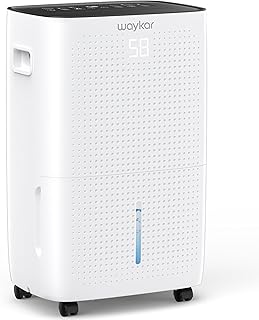
Waykar 150 Pint 7,000 Sq.Ft Dehumidifier
This is the pick for a detached three-car shop or a garage that opens into a damp basement, with a 90° auto-swing louver that spreads dry air across a wide floor instead of drying one corner. The 30%–80% humidity range and continuous drainage support mean you can set 45% in October and genuinely not touch it until spring.
155 Pint Commercial Dehumidifier with Pump
Built for water-damage remediation, which is exactly the durability you want in an environment full of sawdust and road salt. The integrated pump is the real selling point here: it lifts condensate to a sink or window with no floor drain required, and it handles crawl spaces and attics if you need one machine for the whole property.
5000 Sq.Ft Dehumidifier, 100 Pint Smart Humidity Control
An Energy Star Most Efficient award means it pulls comparable water for meaningfully less electricity, which matters when a unit runs eight months a year. Three drainage options and solid casters make it easy to reposition around a project car or a workbench mid-build.
4500 Sq.Ft Energy Star Dehumidifier, 115 Pints/Day
The 45dB compressor is the standout spec, quiet enough that it won’t intrude on a garage doubling as a workshop or home gym. Auto shut-off and auto-restart handle the 1.7-gallon tank sensibly, though for a garage you should still run the hose and skip emptying the bucket entirely.
AEOCKY 4500 Sq.Ft Dehumidifier with Pump
A rare combination of a genuine condensate pump and 2025 Energy Star Most Efficient certification at a mid-tier size, so you get flexible drain routing without a commercial-unit power bill. The intelligent humidistat holds a setpoint tightly rather than hunting, which keeps run hours down.
Frequently Asked Questions
What humidity level should I target in a garage?
Aim for 45–50% relative humidity. That’s low enough to stop rust on unfinished cast iron and keep sheet goods dimensionally stable, but not so low that you’re running the compressor constantly or shrinking wood glue joints in stored assemblies.
Will a dehumidifier work in an unheated garage in winter?
Only if it has auto-defrost, and even then output drops as temperatures fall. Below about 40°F, compressor units become inefficient and a desiccant model or a small amount of supplemental heat is the better answer.
Do I need to seal the garage first?
You’ll get far better results if you do. Replace the bottom door sweep, weatherstrip the service door, and seal obvious slab cracks. An unsealed garage lets the dehumidifier fight outdoor air indefinitely, which drives electricity cost up and lifespan down.
Can I vent the drain hose outside in freezing weather?
Not without risk. A hose run through an exterior wall will freeze at the outlet and back water up into the unit. In winter, drain to an interior floor drain or a bucket inside the heated envelope, or use a pump to reach a utility sink.
Final Thoughts
For most two- and three-car garages, the 5000 Sq.Ft 100 Pint Smart Humidity Control unit hits the best balance of capacity, drainage flexibility, and running cost. If your space is oversized, poorly sealed, or connected to a basement, step up to the Waykar 150 Pint for its 7,000 sq ft coverage and swing-louver distribution. And if there’s no floor drain anywhere near where the machine has to live, the 155 Pint Commercial Dehumidifier with Pump solves that problem outright while giving you a unit tough enough to handle an actual water emergency.