Key takeaways
- Working height vs. listed height: Your reach is roughly the ladder’s height plus your shoulder span, minus the top two rungs you should never stand on. A 12.5-foot model realistically handles single-story gutters and low roof edges; go 15.5 feet for two-story fascia.
- Certification and capacity: Look for EN131 or ANSI compliance and a 330 lb rating. That number covers you plus a paint can, a cordless drill, and a bundle of shingles — don’t buy for your bodyweight alone.
- Rung release mechanism: Individual thumb-tab locks let you deploy partial height, which matters for stair landings and awkward setups. Test that each tab clicks decisively; sloppy locks are the main failure point on budget units.
- Feet and stabilizers: Wide rubber non-slip feet are the minimum. Triangle stabilizer bars at the base add meaningful side-to-side rigidity and are worth the small weight penalty on anything above ten feet.
- Retraction control: Good telescopers collapse in a slow, staged drop rather than a guillotine slam. Check for soft-close or damped retraction if you value your fingertips.
Anyone who has wrestled a 16-foot extension ladder through a stairwell knows the problem: the tool you need for one afternoon of gutter work demands a permanent parking spot in the garage. Collapsible telescoping ladders solve that by nesting each rung into the one below, dropping a full-height ladder down to roughly the size of a golf bag. The tradeoff is that build quality varies wildly between brands, and a wobbly rung release at fourteen feet is not a problem you want to discover mid-climb.
I’ve spent enough weekends on ladders — painting trim, chasing a squirrel out of a soffit, cleaning an RV roof at a campsite — to know what separates a solid telescoper from a scary one. This guide breaks down the specs that actually matter, then walks through the strongest collapsible ladders available in 2026 across the height range, from a compact 6.5-footer for interior work up to a 15.5-foot model for two-story exteriors.
Our top picks



As an Amazon Associate we earn from qualifying purchases at no extra cost to you. Ratings are shown as listed on Amazon.
🛒 Best Price Today on Amazon
Prime members get fast, free shipping on everything above, plus member-only deals. New members get a 30-day free trial — cancel anytime.
How to Choose a Collapsible Ladder (2026)
- Working height vs. listed height: Your reach is roughly the ladder’s height plus your shoulder span, minus the top two rungs you should never stand on. A 12.5-foot model realistically handles single-story gutters and low roof edges; go 15.5 feet for two-story fascia.
- Certification and capacity: Look for EN131 or ANSI compliance and a 330 lb rating. That number covers you plus a paint can, a cordless drill, and a bundle of shingles — don’t buy for your bodyweight alone.
- Rung release mechanism: Individual thumb-tab locks let you deploy partial height, which matters for stair landings and awkward setups. Test that each tab clicks decisively; sloppy locks are the main failure point on budget units.
- Feet and stabilizers: Wide rubber non-slip feet are the minimum. Triangle stabilizer bars at the base add meaningful side-to-side rigidity and are worth the small weight penalty on anything above ten feet.
- Retraction control: Good telescopers collapse in a slow, staged drop rather than a guillotine slam. Check for soft-close or damped retraction if you value your fingertips.
The Best Collapsible Ladders (2026) Reviewed
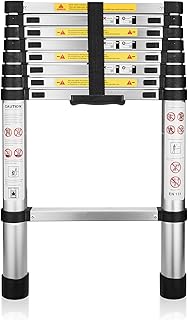
SocTone 12.5FT Telescoping Ladder with Stabilizers
This is the sweet-spot pick for most homeowners: 12.5 feet covers gutters, light fixtures, and RV roofs, and the included triangle stabilizers make a real difference in lateral sway compared to bare-footed competitors. The 330 lb capacity and heavy-gauge aluminum extrusion feel confidence-inspiring underfoot.
BOWEITI 15.5FT Telescoping Ladder
When you genuinely need two-story reach, this is the one — 15.5 feet of aluminum that still collapses down to a carryable bundle. Expect more flex at full extension than shorter models, so keep the base on firm, level ground and don’t skip the stabilizer setup.
10.5FT Telescoping Ladder with Triangle Stabilizers
My favorite compromise between reach and portability: light enough to carry one-handed, tall enough for single-story eaves and RV roof access. The triangle stabilizers and non-slip feet are the standout features at this height class.
8.5FT EN131 Aluminum Multi-Purpose Telescoping Ladder
EN131 certification is the headline here, and it shows in the rung tolerances and lock engagement. At 8.5 feet it’s ideal for interior ceiling work, garage storage, and camper roof hatches without the storage footprint of a taller unit.
6.5FT Aluminum Telescoping Ladder
The apartment-and-closet option — collapses small enough to live in a coat closet or under a bed, yet handles smoke detectors, ceiling fans, and cabinet tops with ease. Same 330 lb rating as the big models, just with a much friendlier storage profile.
Frequently Asked Questions
Are telescoping ladders safe compared to traditional ladders?
Certified models with proper locking rungs are safe when used correctly. The key discipline is confirming every rung is fully locked before climbing and never standing on the top two rungs.
Can I extend a telescoping ladder only partway?
Yes, on any model with individual rung locks. Extend from the top down, lock each rung as you go, and keep both side rails at matching heights.
Do these work as RV or camper ladders?
They’re arguably the best option for RV use, since they store in a compartment rather than eating exterior wall space. Look for the 8.5 to 12.5 foot range for most roof heights.
How do I keep the rungs sliding smoothly?
Wipe the rails clean after outdoor use and hit the sliding surfaces with a dry silicone spray a couple of times a year. Grit in the channels is what causes stuck rungs and sticky locks.
Final Thoughts
For most households, the SocTone 12.5FT with stabilizers hits the right balance of reach, rigidity, and storability. Step up to the BOWEITI 15.5FT if two-story exterior work is on your list, or drop to the 6.5FT aluminum model if you mainly need a compact indoor climber that disappears into a closet.