Key takeaways
- Real airflow, not peak numbers: CFM ratings are often measured at zero pressure. A dual-cylinder unit rated around 10–12.35 ft³/min will genuinely move air at 30 PSI, while a single-cylinder 7 CFM pump is fine for smaller tires and slower work.
- Duty cycle: This is the spec that separates trail-worthy pumps from parking-lot toys. Look for 100% duty cycle or a documented run time at pressure, so you can do all four corners without a cool-down break.
- Power delivery: High-output compressors draw serious amps and need direct battery clamps or a hardwired connection with an inline fuse. Cigarette-lighter plugs cap out fast and will pop a fuse under load.
- Automation you’ll actually use: A digital preset with auto shut-off lets you set 35 PSI, walk away, and come back to a finished tire. It’s the single best quality-of-life upgrade over an analog gauge.
- Hose length and fittings: Nothing kills the mood like a hose that won’t reach the far side of a dually. Aim for 20+ feet of coil or braided line, plus brass quick-connects rather than plastic threads.
What's inside
Airing down for a sand run or a rocky trail is the easy part. Getting back to street pressure afterward is where a lot of us have stood around in the dust, watching a cheap plastic inflator wheeze its way through one 35-inch tire before it overheats and quits. If you’ve ever done the math on four tires at 12 PSI each, you know the difference between a 30-minute chore and a five-minute one comes down entirely to the pump bolted in your bed or tucked in your rear cubby.
This guide is written from a wrench-in-hand perspective: what actually matters in a 12V off-road compressor, which specs are marketing noise, and which units hold up after a season of mud, heat cycling, and bouncing around in a toolbox. Below you’ll find the current standouts for 2026, plus the buying criteria I’d use if I were shopping today.
As an Amazon Associate we earn from qualifying purchases.



🛒 Best Price Today on Amazon
Prime members get fast, free shipping on everything above, plus member-only deals. New members get a 30-day free trial — cancel anytime.
How to Choose a/an Off Road Air Compressor (2026)
- Real airflow, not peak numbers: CFM ratings are often measured at zero pressure. A dual-cylinder unit rated around 10–12.35 ft³/min will genuinely move air at 30 PSI, while a single-cylinder 7 CFM pump is fine for smaller tires and slower work.
- Duty cycle: This is the spec that separates trail-worthy pumps from parking-lot toys. Look for 100% duty cycle or a documented run time at pressure, so you can do all four corners without a cool-down break.
- Power delivery: High-output compressors draw serious amps and need direct battery clamps or a hardwired connection with an inline fuse. Cigarette-lighter plugs cap out fast and will pop a fuse under load.
- Automation you’ll actually use: A digital preset with auto shut-off lets you set 35 PSI, walk away, and come back to a finished tire. It’s the single best quality-of-life upgrade over an analog gauge.
- Hose length and fittings: Nothing kills the mood like a hose that won’t reach the far side of a dually. Aim for 20+ feet of coil or braided line, plus brass quick-connects rather than plastic threads.
The Best Off Road Air Compressor (2026)s Reviewed
ALL-TOP Dual Cylinder 12V Kit (12.35 ft³/Min)
This is the benchmark for high-volume portable inflation, with twin cylinders pushing genuine airflow at working pressure and a 150 PSI ceiling that covers everything from 37s to trailer tires. The included case, battery clamps, and long hose make it a complete kit out of the box, which is rare at this level.
Kohree 12V Dual Cylinder Compressor
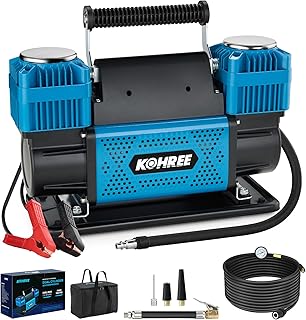
Nearly identical output to the ALL-TOP flagship with a slightly different build and often a friendlier price, making it a strong value pick for weekend wheelers. The metal-bodied cylinders shed heat well, which shows up as consistent performance on tire three and four.
ETENWOLF VORTEX S6 Cordless Inflator
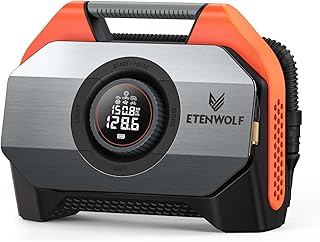
The 19200mAh pack and true 100% duty cycle make this the go-to when you don’t want cables draped across your engine bay, and the LED work light earns its keep on dark trailheads. It won’t match a hardwired dual-cylinder on raw speed for 37s, but for daily driving, bikes, and inflatables it’s the most convenient tool here.
Off-road 12V Inflator with Auto Shut-Off (10.6 CFM)
The digital preset and automatic shut-off are the standout features: dial in your target, connect, and it stops on its own. At 10.6 CFM it sits just under the top dual-cylinder units while offering the most hands-off workflow of the group.
ALL-TOP 12V Portable Inflator (7.06 CFM)
A lighter, more compact option for mid-size trucks, SUVs, and overland trailers where storage space is tight. Inflation is slower than the 12 CFM models, but it’s still leagues ahead of anything you’d find at a gas station.
Frequently Asked Questions
How much CFM do I actually need?
For 33-inch tires and smaller, 7 CFM is workable. Once you’re on 35s or larger, or you’re airing up four tires from 12 PSI regularly, step up to a 10–12 CFM dual-cylinder unit.
Can I run these off the cigarette lighter?
High-output models, no. They need direct battery clamps or a hardwired circuit with an appropriately rated inline fuse. Smaller 7 CFM and cordless units are more forgiving.
Will a 150 PSI rating help me?
Only if you air up trailer, RV, or light-truck tires that run high pressure. For most off-road tires you’ll never exceed 45 PSI, so treat 150 PSI as headroom rather than a daily target.
Do I need a tank?
Not for tires. A tank helps with air tools and fast bead seating, but for inflation alone a direct-drive compressor is lighter, simpler, and cheaper.
Final Thoughts
If you want the fastest air-up with the fewest compromises, the ALL-TOP Dual Cylinder kit is the one I’d bolt in, with the Kohree 12V dual cylinder as a close-value alternative. For anyone who values grab-and-go simplicity over raw speed, the ETENWOLF VORTEX S6 cordless is the smart pick.