Key takeaways
- CFM over PSI: Almost every unit on this list claims 150 PSI max, which is marketing filler since you’ll never inflate a tire past 45. Flow rate is what determines whether four 35-inch tires take eight minutes or forty. Anything under 2 CFM is a bicycle pump with ambitions; 6 CFM and up is genuine truck territory.
- Duty cycle and thermal headroom: A 100% duty cycle rating means the motor can run continuously without a cooldown pause. Dual-cylinder designs split the work and shed heat better, which is why they hold their rated flow deep into a four-tire refill instead of fading.
- Power delivery: Direct battery clamps with heavy-gauge leads beat a 12V socket every time — most accessory sockets fuse at 15A and high-output compressors pull 30A or more. If a kit ships with thin wire and alligator clips that feel like keychain parts, plan on upgrading them.
- Hose reach and fittings: Measure from your battery to your rear-most valve stem, then add slack. Thirty feet of coiled hose sounds excessive until you’re threading it under a rock slider. Brass quick-connects and a proper screw-on chuck are worth the small premium over push-on plastic.
- Cordless versus hardwired: Battery-powered inflators win on convenience for trail repairs and helping strangers in parking lots. Hardwired 12V units win on sustained output. If you already own a 20V tool platform, a bare-tool inflator is a cheap way to cover the light-duty half of the job.
What's inside
Airing down is the easy part. You drop to 15 psi at the trailhead, float over the rocks all afternoon, and then you’re standing in a dirt pullout at dusk with four tires that need to get back to 35 before you touch pavement. That’s the moment a cheap cigarette-lighter pump reveals itself: it heats up around tire two, throttles down, and either quits or takes forty minutes per corner. Anyone who’s built out a rig knows the compressor is the one recovery item you use on literally every trip, and it’s the one most people underbuy.
I’ve bolted these things to bumper brackets, wired them straight to batteries with 10-gauge and an inline fuse, and hauled a couple around loose in a milk crate. This guide breaks down what actually matters in a 12V off-road compressor — real CFM, duty cycle, wire gauge, hose length, clamp quality — and then walks through six units that cover everything from a glovebox top-off pump to a dual-cylinder workhorse that’ll run a locker or an air tool.
As an Amazon Associate we earn from qualifying purchases.




🛒 Best Price Today on Amazon
Prime members get fast, free shipping on everything above, plus member-only deals. New members get a 30-day free trial — cancel anytime.
How to Choose a/an Air Compressor For Off Roading (2026)
- CFM over PSI: Almost every unit on this list claims 150 PSI max, which is marketing filler since you’ll never inflate a tire past 45. Flow rate is what determines whether four 35-inch tires take eight minutes or forty. Anything under 2 CFM is a bicycle pump with ambitions; 6 CFM and up is genuine truck territory.
- Duty cycle and thermal headroom: A 100% duty cycle rating means the motor can run continuously without a cooldown pause. Dual-cylinder designs split the work and shed heat better, which is why they hold their rated flow deep into a four-tire refill instead of fading.
- Power delivery: Direct battery clamps with heavy-gauge leads beat a 12V socket every time — most accessory sockets fuse at 15A and high-output compressors pull 30A or more. If a kit ships with thin wire and alligator clips that feel like keychain parts, plan on upgrading them.
- Hose reach and fittings: Measure from your battery to your rear-most valve stem, then add slack. Thirty feet of coiled hose sounds excessive until you’re threading it under a rock slider. Brass quick-connects and a proper screw-on chuck are worth the small premium over push-on plastic.
- Cordless versus hardwired: Battery-powered inflators win on convenience for trail repairs and helping strangers in parking lots. Hardwired 12V units win on sustained output. If you already own a 20V tool platform, a bare-tool inflator is a cheap way to cover the light-duty half of the job.
The Best Air Compressor For Off Roading (2026)s Reviewed
ALL-TOP Dual Cylinder 12V Kit (12.35 CFM)
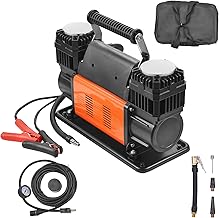
This is the one I’d bolt permanently to a rig running 37s — twin cylinders, a genuinely enormous flow rate, and a hose long enough to walk the whole vehicle without moving the clamps. It’s overkill for a stock 4Runner, but it also runs air tools and reseats a stubborn bead, which no small pump will do.
VEVOR 10.6 CFM Dual-Cylinder Inflator
Nearly the same performance envelope as the big ALL-TOP for noticeably less money, with a solid adapter kit that covers Schrader, Presta, and inflatables. The build quality on the switch and gauge housing feels a step down, so I’d treat the included clamps as a first upgrade.
ALL-TOP 7.06 CFM Single-Cylinder Kit
The sweet spot for most weekend rigs on 33s or 35s. You give up meaningful speed compared to the dual-cylinder version but gain a smaller footprint that actually fits in a drawer system, and the same durable brass fittings carry over.
ETENWOLF VORTEX S6 Cordless
A dual-cylinder pump with a 19,200mAh pack and a true 100% duty cycle — rare in the cordless class, where most units nag you to cool off after one tire. Great for trail-side fixes and dirt-bike duty; less ideal as your only compressor if you air down hard every trip.
DEWALT DCC020IB 20V MAX Inflator
If you already run DEWALT batteries, this is the easiest add to a truck kit: automatic shutoff at your target pressure, a usable LED, and a high-pressure plus high-volume mode. Flow is modest, so think of it as a precision top-off tool rather than a four-tire recovery pump.
Frequently Asked Questions
How much CFM do I actually need?
For 31–33 inch tires, 2–3 CFM is workable. On 35s, aim for 6 CFM or better if you don’t want a twenty-minute wait. Past 37 inches, dual-cylinder units in the 10+ CFM range save real time on every airing-up cycle.
Can I plug one into my 12V accessory socket?
Only the small ones. High-output compressors draw well beyond what a typical socket circuit can supply, and you’ll pop fuses or melt the plug. Wire directly to the battery with an appropriately sized fuse and heavy-gauge cable.
Will these seat a bead?
The 10+ CFM dual-cylinder units can, given a good seal and some patience. Smaller inflators won’t move enough volume. A dedicated bead-seating tool or CO2 tank remains the more reliable answer.
Where should I mount a permanent compressor?
Somewhere dry, ventilated, and away from exhaust heat — an engine bay firewall bracket, a bed-side toolbox, or a rear quarter panel. Keep the intake filter accessible so you can clean it after dusty trips.
Final Thoughts
For serious flow on big tires, the ALL-TOP Dual Cylinder 12.35 CFM kit is the one to build around, with the VEVOR 10.6 CFM close behind as the value play. If you want cordless freedom without giving up duty cycle, the ETENWOLF VORTEX S6 is the smartest compromise on this list.