Key takeaways
- Port size and flow: Match the NPT thread to your existing plumbing, but pay closer attention to CFM rating. A 1/4″ inline trap chokes a sandblaster; a 1/2″ or 3/4″ body rated near 100+ CFM keeps pressure drop negligible even with a hungry HVLP gun.
- Number of stages: Single-stage traps spin out bulk water only. Three-stage systems add a coalescing element for oil aerosols. Four-stage units finish with desiccant beads for genuinely dry air, which is what automotive-grade clear coats demand.
- Drain style: Manual petcocks work if you’re disciplined. Auto drains purge on their own and are worth the premium, since a full bowl passes water straight through as if the filter weren’t there.
- Bowl material: Polycarbonate bowls let you see accumulation but crack under solvent exposure and heat. Metal bowls with a sight glass survive shop abuse far longer.
- Regulator integration: A built-in 0–240 PSI regulator with gauge saves you a fitting and gives you one place to dial in pressure at the point of use rather than at the tank.
What's inside
Anyone who has laid down a coat of lacquer on a refinished dresser only to watch it fisheye knows the culprit isn’t always technique. Compressed air carries water, and lots of it. A standard 60-gallon shop compressor pulling humid summer air can dump a surprising volume of condensate into your lines, and that moisture travels straight through to your spray gun, your plasma torch tip, or your sandblast nozzle. Add in the fine mist of oil that escapes any lubricated pump and you have a recipe for blushing finishes, pitted welds, and rust blooming inside your own air lines.
The fix is a proper water separator, sometimes called a filter-dryer or air drying system, mounted downstream of your tank. This guide walks through what actually matters when you’re choosing one for a home shop or garage woodworking setup, then covers the units worth your money in 2026, from multi-stage industrial towers for full spray booths to compact inline traps for occasional finish work.
As an Amazon Associate we earn from qualifying purchases.




🛒 Best Price Today on Amazon
Prime members get fast, free shipping on everything above, plus member-only deals. New members get a 30-day free trial — cancel anytime.
How to Choose a/an Air Compressor Water Separator (2026)
- Port size and flow: Match the NPT thread to your existing plumbing, but pay closer attention to CFM rating. A 1/4″ inline trap chokes a sandblaster; a 1/2″ or 3/4″ body rated near 100+ CFM keeps pressure drop negligible even with a hungry HVLP gun.
- Number of stages: Single-stage traps spin out bulk water only. Three-stage systems add a coalescing element for oil aerosols. Four-stage units finish with desiccant beads for genuinely dry air, which is what automotive-grade clear coats demand.
- Drain style: Manual petcocks work if you’re disciplined. Auto drains purge on their own and are worth the premium, since a full bowl passes water straight through as if the filter weren’t there.
- Bowl material: Polycarbonate bowls let you see accumulation but crack under solvent exposure and heat. Metal bowls with a sight glass survive shop abuse far longer.
- Regulator integration: A built-in 0–240 PSI regulator with gauge saves you a fitting and gives you one place to dial in pressure at the point of use rather than at the tank.
The Best Air Compressor Water Separator (2026)s Reviewed
3/4″ NPT Industrial 4-Stage Air Drying System
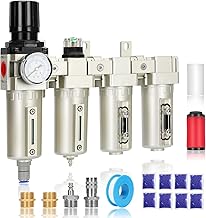
This is the one to bolt on the wall if you run a dedicated finishing area or do any volume of sandblasting, since the 3/4″ body and four-stage progression barely restrict flow. The desiccant stage is the difference between acceptable and genuinely dry, and the auto drain means you’re not crawling behind the compressor between coats.
1/2″ NPT Industrial 3-Stage System with Metal Bowl
A well-balanced pick for the typical two-car-garage shop: particulate filter, coalescing element, and desiccant dryer in a metal-bowl housing that shrugs off dropped clamps and solvent splash. The 0–240 PSI regulator handles everything from a brad nailer to a gravity-feed gun.
1/2″ NPT 4-Stage Air Dryer, 141 CFM
The high flow rating makes this the sensible choice if you occasionally run a plasma cutter alongside spray work, where starving the torch means dirty cuts and short consumable life. Four stages of filtration in a 1/2″ package is unusually good value.
1/2″ NPT 3-Stage Filter Dryer with Regulator
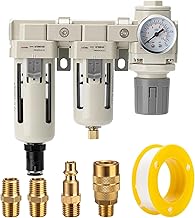
Slightly simpler than the four-stage units and priced accordingly, this covers the vast majority of hobby furniture finishing where you’re shooting waterborne or shellac rather than catalyzed coatings. Auto drain and integrated regulation keep the install to a single wall bracket.
LE LEMATEC AI303 1/4″ Inline Filter
Not a substitute for a wall-mounted system, but excellent as a last-chance trap threaded directly at the gun or torch inlet. LE LEMATEC has been making these for years and the auto-draining design means it won’t slowly fill and start passing slugs of water mid-project.
Frequently Asked Questions
Where should I install a water separator?
As far downstream from the pump as practical. Hot compressed air holds moisture in vapor form, so give it 20–25 feet of pipe to cool and condense before it reaches the filter. Mounting one directly on the tank outlet is the single most common installation mistake.
Do I still need a separator if my compressor is oil-free?
Yes. Oil-free pumps eliminate the oil mist, not the water. Atmospheric humidity is compressed along with the air regardless of pump design.
How often do desiccant beads need replacing?
Depends entirely on your duty cycle and climate, but plan on inspecting them every few months. Most beads change color when saturated. Placing a coalescing stage ahead of the desiccant dramatically extends its life by catching oil before it fouls the media.
Will a separator lower my working pressure?
Every filter creates some pressure drop, but a properly sized unit costs you only a few PSI. Undersizing is what causes real problems, which is why matching CFM rating to your highest-demand tool matters more than matching thread size.
Final Thoughts
For serious finishing work or sandblasting, the 3/4″ NPT four-stage industrial system gives you the most headroom and the driest air of anything here. Most home shops will be better served by the 1/2″ NPT three-stage unit with the metal bowl, which handles typical furniture spraying without overkill, and it’s worth keeping an LE LEMATEC AI303 threaded at the gun as a final safeguard.