Key takeaways
- Motor configuration: Dual-motor designs with independent switches let you run a saw blade on one spindle and a sanding drum or engraving bit on the other, so you stop swapping setups mid-project. Single-motor units are simpler and often quieter, but you will change tooling constantly.
- Real cut depth: Most of these top out between 1/2″ and 26mm, and that number shrinks once the blade is buried in the arbor collar. Measure the thickest stock you actually cut, add a hair, and buy above it — a saw that barely clears your material will burn and stall.
- Variable speed: Seven-step or dial-controlled speed matters more for plastics than for wood. Acrylic melts and welds itself back together at high RPM; dropping the speed and using a fine-tooth blade is the difference between a clean edge and a gummed-up mess.
- Table and fence rigidity: Look for a machined or thick alloy table rather than stamped sheet, and a fence that locks at both ends. Flex is the number one source of tapered cuts on small saws, and no amount of technique fixes a table that bows under hand pressure.
- Tooling and consumables: Check the arbor size and blade diameter before you buy, since odd sizes leave you hunting for replacements. Bundles with 100-plus accessories are handy for polishing and drilling, but the blades in those kits are usually first-project spares, not long-term performers.
What's inside
Anyone who has tried trimming a strip of 1/8″ basswood on a full-size table saw knows the problem: the blade is built for framing lumber, the fence overshoots the piece, and the offcut vanishes into the throat plate. Miniature work — dollhouse trim, model railroad ties, inlay banding, small acrylic panels, PCB blanks — needs a tool scaled to the material, not one you have to fight into submission. That is where the mini table saw category earns its keep, and where it also gets confusing fast, because dozens of near-identical machines roll out of the same handful of factories with different logos stamped on the housing.
I sorted through the current crop with a maker’s checklist: how square the blade sits to the table out of the box, whether the fence stays put under a light push, how much the motor sags when you feed hardwood, and whether the bundled accessories are genuinely useful or just box filler. Below are the models worth your bench space in 2026, plus the specs that actually predict good cuts and the ones that are marketing noise.
As an Amazon Associate we earn from qualifying purchases.
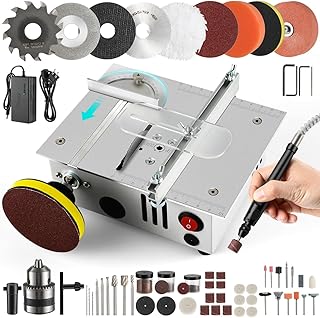
![Mini Table Saw for Crafts & Hobbyists [Dual 795 Motors & Switches] 200W/12,000RPM/26mm Adjustable Height with Accessories – Perfect for DIY Crafts, Handmade Gifts & Exploring Hobbies](https://m.media-amazon.com/images/I/71yotzYsRaL._AC_UL320_.jpg)

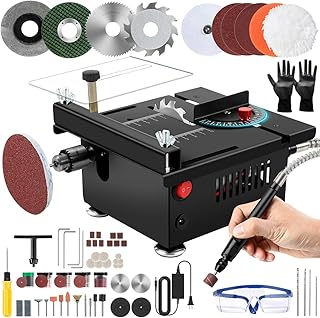
![Super Mini Table Saw for Crafts & Hobbyists, [Dual Motor & Switches] 7 Speeds 200W Max, Multifunctional, 122+ Accessories, Cut/Engrave/Polish/Drill, Compact for Model Making, Gift for Creators](https://m.media-amazon.com/images/I/71XhPTpz18L._AC_UL320_.jpg)

🛒 Best Price Today on Amazon
Prime members get fast, free shipping on everything above, plus member-only deals. New members get a 30-day free trial — cancel anytime.
How to Choose a Mini Table Saw For Crafts (2026)
- Motor configuration: Dual-motor designs with independent switches let you run a saw blade on one spindle and a sanding drum or engraving bit on the other, so you stop swapping setups mid-project. Single-motor units are simpler and often quieter, but you will change tooling constantly.
- Real cut depth: Most of these top out between 1/2″ and 26mm, and that number shrinks once the blade is buried in the arbor collar. Measure the thickest stock you actually cut, add a hair, and buy above it — a saw that barely clears your material will burn and stall.
- Variable speed: Seven-step or dial-controlled speed matters more for plastics than for wood. Acrylic melts and welds itself back together at high RPM; dropping the speed and using a fine-tooth blade is the difference between a clean edge and a gummed-up mess.
- Table and fence rigidity: Look for a machined or thick alloy table rather than stamped sheet, and a fence that locks at both ends. Flex is the number one source of tapered cuts on small saws, and no amount of technique fixes a table that bows under hand pressure.
- Tooling and consumables: Check the arbor size and blade diameter before you buy, since odd sizes leave you hunting for replacements. Bundles with 100-plus accessories are handy for polishing and drilling, but the blades in those kits are usually first-project spares, not long-term performers.
The Best Mini Table Saw For Crafts (2026)s Reviewed
Mini Table Saw with Dual 795 Motors (200W, 12,000 RPM)
The twin 795 motors and separate switches make this the most flexible pick for anyone who alternates between cutting and shaping in one sitting, and the 26mm adjustable height handles most hobby stock with room to spare. It runs at a fixed high RPM, so slow your feed rate on acrylic and let the blade clear its own chips.
MIMYTH Multifunctional Portable Table Saw
MIMYTH’s strength is adjustability: angle, speed, and depth are all dialed in independently, which makes repeat bevel cuts on trim and molding far less fussy than on fixed-angle rivals. Worth checking blade square with a small engineer’s square before the first project, as shipping knocks the tilt scale off on occasion.
Super Mini Table Saw with 7 Speeds and 122+ Accessories
This is the best starting point for model builders who do not yet own a rotary tool, because the accessory set covers engraving, polishing, and drilling alongside sawing. Seven speed steps plus dual motors give it genuine range, though the sheer accessory count means quality varies piece to piece.
MXBAOHENG Mini Table Saw S3
The S3 is the precision option here — a tidier table, a more confident fence lock, and a seven-speed supply that holds steady rather than surging. Cut depth caps at 1/2″, so it suits veneer, thin hardwood, and miniature framing rather than chunky stock.
Mini Multi Functional Table Saw (Dual-Motor, Wood/PCB/Acrylic)
Aimed squarely at electronics and mixed-material work, this dual-motor unit handles PCB blanks, plastics, and softwood without complaint once you match speed to material. The angle adjustment is basic but repeatable, making it a sensible second saw for a shared bench.
Frequently Asked Questions
Can a mini table saw cut hardwood?
Yes, within limits. Maple, walnut, and oak cut cleanly up to roughly 1/4″ to 3/8″ thick if you use a fine-tooth blade and a slow, steady feed. Push harder and the motor bogs, which scorches the cut and shortens brush life.
Do these saws need a dust collection setup?
Nothing elaborate, but do not skip it entirely. A small shop vac nozzle clamped near the blade catches most of the fine dust these saws throw, which otherwise coats your bench and your lungs. Safety glasses are non-negotiable at 12,000 RPM.
How accurate are the built-in angle and depth scales?
Treat them as starting points. On saws in this class, printed scales are typically within a degree or two, so verify with a square or digital angle gauge and cut a test piece in scrap before committing to your good stock.
What blade should I use for acrylic and plastic?
A high-tooth-count blade at reduced speed, every time. Coarse wood blades chip acrylic and can grab, while a fine blade run slower shears the material and leaves an edge you only need to lightly sand.
Final Thoughts
For most craft benches, the Dual 795 Motor mini saw is the strongest all-rounder thanks to its deeper 26mm capacity and independent tool stations. If precision matters more than capacity — inlay, dollhouse trim, fine framing — the MXBAOHENG S3 is the steadier cutter, while the Super Mini with its seven speeds and large accessory kit is the smartest single purchase for someone building a hobby setup from scratch.