Key takeaways
- Battery ecosystem first: If you already own Makita LXT or DeWalt 20V packs, a tool-only router saves real money and keeps your charger shelf sane. If you’re starting fresh, a 21V kit with two 4.0Ah batteries gets you running the same afternoon — just accept that those packs won’t power anything else you own later.
- Base material and flatness: An aluminum base beats stamped steel or plastic for one reason: it stays flat. A base that rocks even slightly will telegraph into every chamfer and dado you cut. Check the base plate against a straightedge when it arrives, before you cut anything you care about.
- Speed range over peak RPM: A 30,000 RPM headline number means little if the low end is 16,000. You want a genuine spread so you can drop speed for large-diameter profile bits without burning, and climb back up for narrow straight bits in hardwood. Six discrete steps is plenty.
- Depth adjustment mechanism: This is where budget routers reveal themselves. Look for a rack-and-pinion or fine-thread micro-adjust with a clamp that locks without shifting. A friction-fit slider will creep mid-cut, and you’ll find out on the last pass.
- Dust management: Cordless means no cord, but chips still fly straight into your sightline. A shroud or extraction port that accepts a standard shop-vac hose turns freehand template work from a squinting exercise into something you can actually see.
Trailing a cord across a half-finished tabletop is the fastest way to gouge a workpiece you just spent three hours flattening. That’s the real argument for a cordless palm router: not convenience, but control. Once the extension cord stops fighting you, edge-following gets smoother, template work gets cleaner, and you stop repositioning the whole project just to reach the far side. The catch is that the cordless trim router market has filled up with near-identical 21V units, and the spec sheets all read the same until you actually put one against oak.
I’ve sorted through the current crop with a workshop bias: how the base tracks on a curved edge, whether the speed dial actually holds under load, how the collet grips after a few dozen bit changes, and whether the included bit set is usable or landfill. Below you’ll find the models worth your bench space in 2026, plus the specs that genuinely separate them and the ones that are just marketing noise.
Our top picks




As an Amazon Associate we earn from qualifying purchases at no extra cost to you. Ratings are shown as listed on Amazon.
🛒 Best Price Today on Amazon
Prime members get fast, free shipping on everything above, plus member-only deals. New members get a 30-day free trial — cancel anytime.
How to Choose a Cordless Wood Router (2026)
- Battery ecosystem first: If you already own Makita LXT or DeWalt 20V packs, a tool-only router saves real money and keeps your charger shelf sane. If you’re starting fresh, a 21V kit with two 4.0Ah batteries gets you running the same afternoon — just accept that those packs won’t power anything else you own later.
- Base material and flatness: An aluminum base beats stamped steel or plastic for one reason: it stays flat. A base that rocks even slightly will telegraph into every chamfer and dado you cut. Check the base plate against a straightedge when it arrives, before you cut anything you care about.
- Speed range over peak RPM: A 30,000 RPM headline number means little if the low end is 16,000. You want a genuine spread so you can drop speed for large-diameter profile bits without burning, and climb back up for narrow straight bits in hardwood. Six discrete steps is plenty.
- Depth adjustment mechanism: This is where budget routers reveal themselves. Look for a rack-and-pinion or fine-thread micro-adjust with a clamp that locks without shifting. A friction-fit slider will creep mid-cut, and you’ll find out on the last pass.
- Dust management: Cordless means no cord, but chips still fly straight into your sightline. A shroud or extraction port that accepts a standard shop-vac hose turns freehand template work from a squinting exercise into something you can actually see.
The Best Cordless Wood Router (2026)s Reviewed
SEESII 21V Brushless Compact Palm Router
The aluminum base and LED readout put this one ahead of the generic pack — you can see your speed setting instead of guessing at a numbered dial, and the base tracks confidently on curved stock. The dust extraction port is a genuine port, not a decorative nub, which matters more than the eight-bit set it ships with.
Cordless Brushless Router for DeWalt 20V/60V
At 600W and 28,000 RPM on a fixed base, this is the pick if you’re already invested in DeWalt packs and want a dedicated trim router without a second battery platform. Tool-only pricing means the twelve included bits are effectively the bonus rather than the justification.
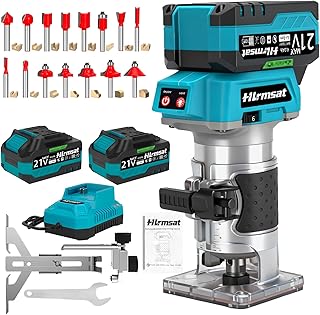
21V Brushless Router with 20PC Bit Set
The twenty-piece bit assortment and dual 4.0Ah batteries make this the most complete starting point for someone with no cordless platform yet. Six-speed control handles slotting and trimming competently; treat the bits as a learning set and upgrade your two most-used profiles to carbide when you find them.
Cordless Compact Router for Makita Battery
Built for LXT owners who don’t want another charger, this one pairs a 30,000 RPM brushless motor with a dust hood that actually keeps the cut line visible. Five bits is thin, but Makita-platform buyers usually already have a drawer of them.
JEXUGK 21V Brushless Palm Router
A solid mid-pack kit with two batteries and fifteen bits, comfortable enough one-handed for extended edge work on cabinet doors. Nothing exotic in the feature list, but the six-speed dial holds steady and the grip diameter suits smaller hands better than most.
Frequently Asked Questions
Can a cordless router handle hardwood?
Yes, in multiple shallow passes. A brushless 21V trim router will cut clean profiles in oak, maple, and walnut if you limit depth of cut to roughly 1/8 inch per pass and let the bit clear chips. Trying to hog a full-depth groove in one go is what kills batteries and burns edges.
How long does a 4.0Ah battery last?
Expect roughly 25 to 40 minutes of intermittent trimming per pack, less in dense hardwood at high speed. That’s why the two-battery kits matter — one charges while the other works, and you never stop mid-project.
Do these accept 1/2 inch bits?
No. Compact palm routers use 1/4 inch collets exclusively, which covers the vast majority of furniture work: roundovers, chamfers, dadoes, dovetails, and flush trimming. Large panel-raising bits still require a corded plunge router.
Is a fixed base limiting?
For furniture work, rarely. Fixed-base trim routers excel at edge profiling and template routing, which is most of what furniture building demands. You’d want a plunge base for interior mortises and stopped dadoes, which is a separate tool purchase.
Final Thoughts
For most furniture builders starting fresh, the SEESII palm router is the one I’d reach for — the aluminum base, LED display, and real extraction port address the three things that actually frustrate you in daily use. If you already run DeWalt packs, the DeWalt-compatible brushless router is the smarter spend, and Makita owners should go straight to the LXT-compatible compact model with the dust hood. Any of the three will outperform a corded trim router on curved work, simply because nothing is pulling against your hands.