Key takeaways
- CFM over gallons: A brad nailer sips roughly 0.3 CFM at 90 PSI; a framing nailer can demand 2 CFM or more in fast sequence. Match the compressor’s rated CFM at 90 PSI to your hungriest tool, then add margin if a second person will be shooting nails too.
- Recovery time: Tank capacity buys you a buffer, but recovery is what keeps you working. A one-gallon unit that refills in 15 seconds often outperforms a lazy larger tank for intermittent trim work.
- Noise, measured honestly: Anything in the 58 to 70 dB range is conversation-level and fine for a shared garage or an occupied house. Traditional oil-free pancakes commonly run 78 to 90 dB, which means hearing protection and irritated housemates.
- Oil-free versus oil-lubed: Oil-free pumps mean zero maintenance and no tipping worries when you toss the unit in a truck bed. Oil-lubed pumps run cooler and quieter over long duty cycles but need routine checks. For furniture and trim, oil-free is the practical default.
- Portability and fittings: Weigh the unit against how often it moves. Also check the coupler: a universal quick-connect saves you a trip to the hardware store for adapters, and dual outlets let two nailers share the tank without a splitter.
Nothing derails a Saturday build faster than a compressor that can’t keep up. You’re halfway through pinning face frames or shooting a row of baseboard, and the motor is still grinding away trying to claw back pressure. The nailer starts sinking fasteners at half depth, you back off to let the tank recover, and the rhythm you had going is gone. The frustrating part is that most people buying their first compressor shop by tank size alone, when recovery rate, cut-in pressure, and noise level are what actually decide whether the thing feels like a tool or an obstacle.
This guide comes from time spent in a garage shop wiring up brad nailers, 16-gauge finish guns, and the occasional framing nailer for deck and built-in work. Below you’ll find picks that span the realistic range of home furniture and trim work: a job-site pancake that can feed two guns at once, a couple of genuinely quiet one-gallon units for indoor assembly, a cordless option for jobs where dragging a cord is the worst part, and a big vertical tank for anyone who wants headroom. We’ll also cover the specs that matter so you can judge any compressor on the shelf, not just these.
Our top picks



As an Amazon Associate we earn from qualifying purchases at no extra cost to you.
🛒 Best Price Today on Amazon
Prime members get fast, free shipping on everything above, plus member-only deals. New members get a 30-day free trial — cancel anytime.
How to Choose a Air Compressor For Nail Guns (2026)
- CFM over gallons: A brad nailer sips roughly 0.3 CFM at 90 PSI; a framing nailer can demand 2 CFM or more in fast sequence. Match the compressor’s rated CFM at 90 PSI to your hungriest tool, then add margin if a second person will be shooting nails too.
- Recovery time: Tank capacity buys you a buffer, but recovery is what keeps you working. A one-gallon unit that refills in 15 seconds often outperforms a lazy larger tank for intermittent trim work.
- Noise, measured honestly: Anything in the 58 to 70 dB range is conversation-level and fine for a shared garage or an occupied house. Traditional oil-free pancakes commonly run 78 to 90 dB, which means hearing protection and irritated housemates.
- Oil-free versus oil-lubed: Oil-free pumps mean zero maintenance and no tipping worries when you toss the unit in a truck bed. Oil-lubed pumps run cooler and quieter over long duty cycles but need routine checks. For furniture and trim, oil-free is the practical default.
- Portability and fittings: Weigh the unit against how often it moves. Also check the coupler: a universal quick-connect saves you a trip to the hardware store for adapters, and dual outlets let two nailers share the tank without a splitter.
The Best Air Compressor For Nail Guns (2026)s Reviewed
Metabo HPT EC914S 6-Gallon Pancake
With 4 CFM of flow and 200 PSI of stored pressure, this is the pick when you need to run a framing or roofing nailer without babysitting the gauge, and it genuinely supports two guns at once for deck or subfloor days. It’s the loud, capable workhorse of this list: not what you want beside a sleeping baby, but the one I’d grab for structural work.
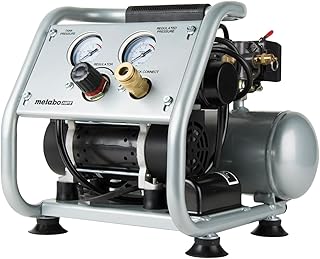
Metabo HPT EC28M 1-Gallon Quiet
At 59 dB this runs quiet enough that you’ll hear the nailer more than the pump, which changes how it feels to work indoors on cabinets or wainscoting. The universal quick coupler is a small detail that pays off constantly when you’re swapping between a pin nailer and a finish gun mid-project.
Cordless Tank-Free Mini Compressor (18V)
This runs off Miwoqi 18V packs and skips the tank entirely, feeding air on demand instead, which makes it excellent for punch-list trim, installs in finished rooms, and anywhere an extension cord is a tripping hazard. It’s not built for sustained framing, but for a few dozen brads at a time it’s liberating.
14.5-Gallon Ultra Quiet Vertical Compressor
8.75 CFM and a vertical footprint make this the shop-anchor choice: it takes up floor space roughly the size of a shop vac while delivering enough air for nailers, blowguns, and light spray work. The 70 dB rating is remarkable for this size class, though the 115 PSI ceiling means less stored reserve than a 200 PSI pancake.
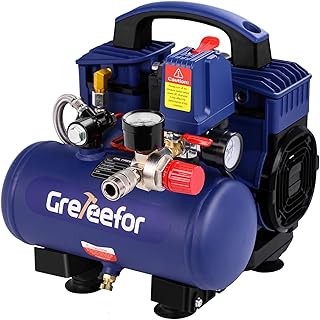
1-Gallon Ultra Quiet 60 dB Portable
A 13-second fill from empty and a 60 dB rating make this a strong grab-and-go unit for finish work, and the 1.5 HP motor keeps up with an 18-gauge nailer at a steady pace. It’s the compressor I’d recommend to someone building their first set of furniture projects who also wants to top off tires.
Frequently Asked Questions
What size compressor do I need for a brad nailer?
A one-gallon oil-free unit is plenty. Brad and pin nailers use very little air per shot, so recovery speed and noise matter far more than tank volume for cabinet, trim, and furniture work.
Can one compressor run two nailers at the same time?
Yes, if the CFM rating supports it. Look for at least 4 CFM at 90 PSI and two outlets, like the six-gallon pancake above. Splitting a small one-gallon tank between two guns will leave both of you waiting.
Do I need to drain the tank after every use?
Drain it after each session, or at minimum weekly. Compressing air condenses moisture inside the tank, and standing water causes rust that weakens the vessel and can spit droplets into your tools.
Why is my nailer not sinking nails all the way?
Usually low pressure or an undersized hose. Set the regulator to your nailer’s spec, typically 90 to 100 PSI, use a hose at least 1/4 inch in diameter, and check that the compressor has finished its recovery cycle before firing again.
Final Thoughts
For most home furniture and trim projects, the Metabo HPT EC28M is the sweet spot: quiet enough to use indoors, light enough to carry one-handed, and paired with a coupler that makes tool swaps painless. Step up to the Metabo HPT EC914S if framing, decking, or two-gun days are in your future, and consider the 14.5-gallon vertical unit if you want a permanent shop setup with room to grow into spraying and air tools.