Key takeaways
- Sliding vs. fixed head: A fixed chop saw tops out around 6 inches of crosscut, which covers most furniture rails and stiles. If you’re cutting shelf boards, table aprons wider than a 1×6, or trimming glued-up panels, a slide rail earns its extra footprint and cost immediately.
- Single vs. dual bevel: Single bevel means flipping the workpiece for opposing angles, which introduces error on crown or complex mitered boxes. Dual bevel lets you tilt left and right without moving stock, and for anything with compound joinery it’s the difference between one setup and four.
- Cut line indication: Lasers are fine for rough work but shift out of calibration and get lost under shop lighting. LED shadow-line systems cast the actual blade silhouette, so what you see is where the teeth land, regardless of blade thickness or kerf.
- Detent and fence quality: Test the positive stops for play before you trust them. A saw that clicks into 45 degrees but lets the table creep under pressure will cost you every mitered corner you cut, and no amount of clamping fixes a sloppy pivot.
- Dust management and portability: Stock dust bags on 10-inch saws capture maybe half the chips. Check for a proper 1-1/4 or 2-inch port that mates to a shop vac, and weigh the saw honestly against how often you’ll be moving it between garage and job site.
What's inside
A 10-inch miter saw sits in an awkward spot in the tool lineup. It’s big enough to handle real furniture stock but small enough that plenty of shoppers assume any model will do, then discover halfway through a set of dining chair legs that their saw can’t clear a 4-inch apron in one pass, or that the fence drifts a degree every time they lock the miter detent. The specs on the box rarely tell you which of these you’re buying. Blade diameter is the same across every model here; what separates them is crosscut capacity, whether the head slides, how honestly the bevel scale reads, and how much slop is in the pivot after a hundred cuts.
I’ve built enough face frames, bed rails, and mitered casework to know which features actually earn their keep on a home shop bench. This guide breaks down six 10-inch saws that cover the realistic range for furniture work: corded workhorses, sliding models for wide panels, a cordless option for anyone building on site, and a couple of budget picks that punch above their price. I’ll flag where each one shines and where you’ll be compensating with jigs and patience.
As an Amazon Associate we earn from qualifying purchases.


🛒 Best Price Today on Amazon
Prime members get fast, free shipping on everything above, plus member-only deals. New members get a 30-day free trial — cancel anytime.
How to Choose a 10in Miter Saw (2026)
- Sliding vs. fixed head: A fixed chop saw tops out around 6 inches of crosscut, which covers most furniture rails and stiles. If you’re cutting shelf boards, table aprons wider than a 1×6, or trimming glued-up panels, a slide rail earns its extra footprint and cost immediately.
- Single vs. dual bevel: Single bevel means flipping the workpiece for opposing angles, which introduces error on crown or complex mitered boxes. Dual bevel lets you tilt left and right without moving stock, and for anything with compound joinery it’s the difference between one setup and four.
- Cut line indication: Lasers are fine for rough work but shift out of calibration and get lost under shop lighting. LED shadow-line systems cast the actual blade silhouette, so what you see is where the teeth land, regardless of blade thickness or kerf.
- Detent and fence quality: Test the positive stops for play before you trust them. A saw that clicks into 45 degrees but lets the table creep under pressure will cost you every mitered corner you cut, and no amount of clamping fixes a sloppy pivot.
- Dust management and portability: Stock dust bags on 10-inch saws capture maybe half the chips. Check for a proper 1-1/4 or 2-inch port that mates to a shop vac, and weigh the saw honestly against how often you’ll be moving it between garage and job site.
The Best 10in Miter Saws (2026) Reviewed
Metabo HPT MultiVolt 36V Sliding Miter Saw (C3610DRAQA)
This is the most capable saw in the group, pairing a brushless slide mechanism with dual bevel and the option to run off battery or an AC adapter, so cordless convenience doesn’t cap your runtime. The compact rail design means it doesn’t need clearance behind the bench, which matters more in a crowded garage than most spec sheets acknowledge.
Metabo HPT C10FCG2 Single Bevel Compound Miter Saw
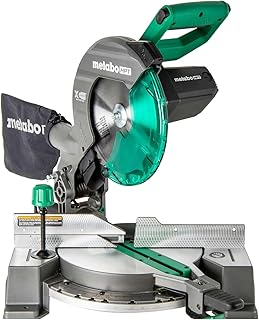
At roughly 24 pounds with the Xact Cut shadow line instead of a laser, this corded saw is the smartest buy for anyone building furniture from dimensional stock and carrying the tool between spaces. You give up sliding capacity, but the miter detents hold true and the shadow line makes repeat cuts genuinely repeatable.
SKIL MS6305-00 10″ Dual Bevel Sliding Compound Miter Saw
SKIL delivers dual bevel and slide capacity at a price that usually buys a single-bevel chop saw, which makes it the value pick for casework and wide panel trimming. The fence and table finish aren’t premium grade, so budget an afternoon for calibration before you cut anything that matters.
DOVAMAN 10-Inch Sliding Miter Saw
The dual-speed motor and three included TCT blades signal the intent here: this saw wants to cut aluminum extrusion and plastic laminate alongside hardwood. The 3.5 by 13.4-inch maximum cut is generous for the class, though the ambidextrous handle takes some acclimating if you’ve been running conventional saws.
Hoteche 10-Inch 15-Amp Compound Miter Saw
A straightforward single-bevel chop saw with laser guidance and enough amperage to push through hardwood without bogging. It’s an entry-level tool in fit and finish, best suited to shop cutoffs, framing lumber, and anyone who needs a second saw dedicated to rough stock.
Frequently Asked Questions
Is a 10-inch saw big enough for furniture building?
For the vast majority of it, yes. Table legs, rails, stiles, and drawer parts all fall well within a 10-inch saw’s range, and a sliding model handles shelf boards and aprons up to roughly 12 inches. You’d only need 12-inch capacity for wide crown, deep timber, or nested baseboard.
Should I replace the included blade?
Usually, yes. Factory blades in the 24 to 40 tooth range are built for framing speed, not clean crosscuts in cherry or maple. An 80-tooth thin-kerf blade transforms cut quality on hardwood and plywood, and it’s the single cheapest upgrade you can make.
How do I check whether my saw is actually square?
Cut a piece of scrap wider than 4 inches, flip one half over, and butt the cut faces together against a straightedge. Any gap is double your actual error. Do the same test at 45 degrees before you trust the detents, and recheck after transporting the saw.
Is a cordless miter saw worth the premium?
If you install as well as build, yes. Cordless saws like the MultiVolt eliminate cord management on site and lose very little power to battery operation on 10-inch blades. For a saw that lives permanently on a shop station, corded is the better use of money.
Final Thoughts
If you want one saw to handle everything from case sides to compound miters, the Metabo HPT C3610DRAQA MultiVolt is the strongest overall choice, with dual bevel, slide capacity, and corded-or-cordless flexibility. For a shop-based furniture maker who cuts mostly dimensional stock, the Metabo HPT C10FCG2 delivers better precision per dollar than anything else here thanks to its shadow-line cut indicator and light weight. And if you need sliding dual-bevel capability on a tight budget, the SKIL MS6305-00 is worth the calibration time it asks for.