Key takeaways
- Runner material: UHMW plastic slides smoothly, shrugs off rust, and stays dimensionally stable in a damp garage, making it the practical default. Extruded aluminum bars feel more rigid and often include set screws for dialing out play, which suits heavier sleds and frequent production runs.
- Slot fit: Measure your miter slots before ordering. The 3/4″ x 3/8″ standard covers most cabinet and contractor saws, but T-shaped slots need runners profiled to accept the undercut. Adjustable bars with expansion screws are the safest bet if your slots are slightly oversized or worn.
- T-track and hardware: Kits that include aluminum T-track let you add stop blocks, flip stops, and hold-downs later. Check track length against your intended fence, and confirm the kit ships with the knobs, bolts, and screws you actually need rather than assuming you have spares.
- Zero-clearance support: A sled base that closes tightly around the blade kerf backs up the fibers on the underside of your cut, which matters enormously for plywood, veneer, and end grain. Replaceable inserts are worth seeking out.
- Capacity versus footprint: A wide sled crosscuts big panels but hogs bench space and gets heavy. A compact small-parts sled handles the cuts most likely to send fingers near the blade. Many shops end up with one of each.
Anyone who has tried to crosscut a 14-inch cabinet rail using only the stock miter gauge knows the feeling: the workpiece creeps mid-cut, the offcut pinches, and what should have been a square shoulder comes off the blade a degree and a half out. It is not a skill problem. A miter gauge supports the wood at one small point behind the blade, so every bit of drag translates into rotation. Sheet goods make it worse, small parts make it dangerous, and repeatability goes out the window entirely.
A crosscut sled fixes all of that by carrying the workpiece on a flat base that rides in the miter slots, so wood and fence move together as one unit. This guide covers both routes to getting one: hardware kits that supply the T-track, runners, and knobs so you can build a sled sized to your saw and your shop, and a ready-made sled for the small-parts work most of us handle badly. We look at runner material, adjustability, slot compatibility, and how each option behaves after a few seasons of humidity swings.
Our top picks


As an Amazon Associate we earn from qualifying purchases at no extra cost to you. Ratings are shown as listed on Amazon.
🛒 Best Price Today on Amazon
Prime members get fast, free shipping on everything above, plus member-only deals. New members get a 30-day free trial — cancel anytime.
How to Choose a/an Table Saw Sleds (2026)
- Runner material: UHMW plastic slides smoothly, shrugs off rust, and stays dimensionally stable in a damp garage, making it the practical default. Extruded aluminum bars feel more rigid and often include set screws for dialing out play, which suits heavier sleds and frequent production runs.
- Slot fit: Measure your miter slots before ordering. The 3/4″ x 3/8″ standard covers most cabinet and contractor saws, but T-shaped slots need runners profiled to accept the undercut. Adjustable bars with expansion screws are the safest bet if your slots are slightly oversized or worn.
- T-track and hardware: Kits that include aluminum T-track let you add stop blocks, flip stops, and hold-downs later. Check track length against your intended fence, and confirm the kit ships with the knobs, bolts, and screws you actually need rather than assuming you have spares.
- Zero-clearance support: A sled base that closes tightly around the blade kerf backs up the fibers on the underside of your cut, which matters enormously for plywood, veneer, and end grain. Replaceable inserts are worth seeking out.
- Capacity versus footprint: A wide sled crosscuts big panels but hogs bench space and gets heavy. A compact small-parts sled handles the cuts most likely to send fingers near the blade. Many shops end up with one of each.
The Best Table Saw Sleds (2026)s Reviewed
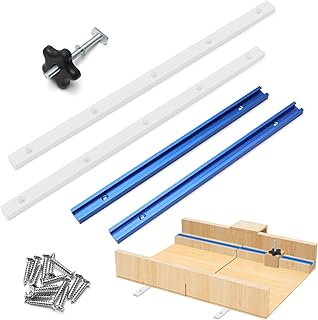
21P Table Saw Sled Kit with T-Track and UHMW Miter Bars
This is the most complete starting point of the group: two aluminum T-tracks, two UHMW miter bars, and predrilled holes that let you fasten runners to your base without spending an evening laying out screw positions. Cut your own plywood platform and you get a sled sized exactly to your saw with far better fit than most bargain factory units.
Rockler Small Parts Crosscut Sled
The one genuinely finished sled here, and it earns its place by tackling the cuts people improvise on: short blocks, tenon cheeks, and thin trim pieces. Zero-clearance support keeps the offcut from diving into the throat plate, and the compact base stores upright in a corner instead of dominating the bench.
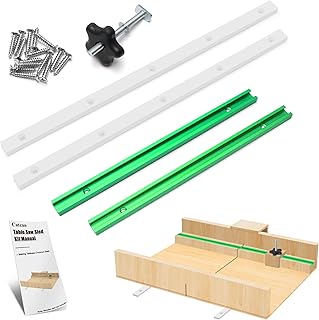
Catcan Crosscut Sled Kit with 12″ T-Track and 17″ Bars
A tidy, well-specified kit for a mid-size sled, with 17-inch UHMW bars that provide plenty of registration length and 12-inch track segments suited to a single stop block setup. The included knob and bolt hardware means you can mount an adjustable stop the same afternoon you build the base.
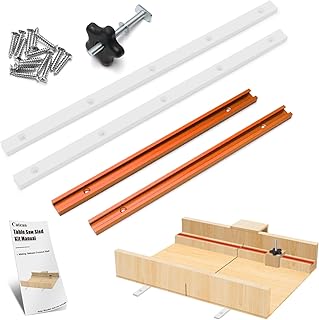
Catcan Crosscut Sled Kit for Table Saw Runners
Functionally the sibling of the kit above, this bundle is the pick when you want the same UHMW-and-aluminum combination with slightly different track proportions for a narrower sled or a dedicated tapering jig. Fit and finish on the bars is consistent, and they wax up nicely for a glass-smooth stroke.
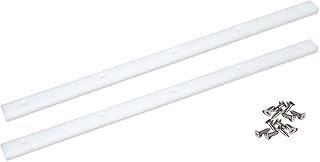
O’SKOOL Aluminum Miter Bars, 430mm
These adjustable aluminum bars are the upgrade path for anyone fighting slop in worn miter slots, with expansion screws that let you tune the fit until side-to-side play essentially disappears. At 430mm they suit larger sleds, and compatibility with both T-shaped and U-slots makes them useful across the saw, router table, and bandsaw.
Frequently Asked Questions
Do I need to build a sled, or can I just buy one?
Buying makes sense for specialized tasks like small-parts cutting, where a purpose-built sled is hard to beat. For general crosscutting, a shop-built sled using a quality runner and track kit almost always fits your specific saw better and costs less.
How do I get the fence perfectly square?
Use the five-cut method. Trim all four edges of a square offcut, measure the taper on the fifth cut, and divide the error by four to calculate exactly how far to nudge the fence. It reliably gets you within a thousandth over a foot.
Will UHMW runners loosen over time?
UHMW is stable, but plywood bases move seasonally and slots collect dust. Clean the slots regularly and rub paraffin on the runners. If you notice play developing, adjustable aluminum bars solve it permanently.
Does a sled reduce my depth of cut?
Yes. Sled base thickness comes straight off your maximum height, so a 1/2-inch base leaves roughly 2 3/4 inches on a typical 10-inch saw. Keep the base as thin as rigidity allows.
Final Thoughts
For most shops, the 21P Table Saw Sled Kit is the best value, giving you every piece of hardware needed to build a sled tailored to your saw. Pair it with the Rockler Small Parts Crosscut Sled for the short, finger-risky cuts, and step up to the O’SKOOL Aluminum Miter Bars if your slots are worn and you want adjustment screws to chase out the last bit of play.