Key takeaways
- Fence quality above all else: A rack-and-pinion fence that stays parallel through its full travel is worth more than any horsepower claim. Test it by locking down at 6 inches and 24 inches, then measuring front and back of the blade — anything over 1/64″ of drift means burn marks and kickback risk on long rips.
- Rip capacity vs. your actual projects: Cabinet builders want 24″+ to the right of the blade so a plywood panel can be halved in one pass. If you mostly work in solid stock under 12″ wide, save the money and the bench space.
- Depth of cut at 90 and 45 degrees: A 3″+ vertical cut handles 4×4 posts and stacked stock. Check the bevel figure separately — it drops sharply, and a saw that gives you only 2.2″ at 45° won’t miter thick table aprons.
- Dust management that actually connects: Look for a shrouded blade housing plus a standard 2-1/2″ port. Open-bottom designs blast fine dust straight onto your floor and into the motor windings.
- Stand and portability tradeoff: A folding rolling stand adds 30 pounds but makes one-person setup realistic. Pure benchtop units are lighter to haul, though you’ll need a solid surface waiting at the other end.
Shopping for a table saw with a $500 ceiling means wading through a lot of noise. Spec sheets all shout the same numbers — 15 amps, 10 inches, 5000 RPM — while the parts that actually decide whether you enjoy using the thing rarely get mentioned. Fence squareness, miter slot tolerance, whether the arbor lock nut strips after a dozen blade swaps, how much the tabletop flexes when you lean on it mid-rip. I’ve built enough shop furniture on cheap saws to know that a wobbly fence turns a two-hour cabinet job into a full afternoon of shimming and re-cutting.
This guide sorts the sub-$500 field by what matters at the bench. I’ve grouped picks by the job they’re best suited to — breaking down sheet goods for casework, precision rips for face frames, or portable work where the saw travels more than it sits. Below you’ll find current picks, then a buying framework, short reviews of the standouts, and answers to the questions that come up most from readers building their first real furniture piece.
Our top picks

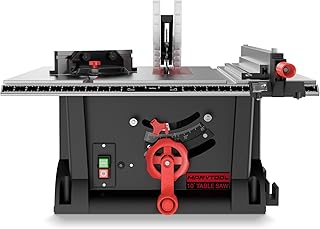



As an Amazon Associate we earn from qualifying purchases at no extra cost to you. Ratings are shown as listed on Amazon.
🛒 Best Price Today on Amazon
Prime members get fast, free shipping on everything above, plus member-only deals. New members get a 30-day free trial — cancel anytime.
How to Choose a Table Saw Under 500 Dollars (2026)
- Fence quality above all else: A rack-and-pinion fence that stays parallel through its full travel is worth more than any horsepower claim. Test it by locking down at 6 inches and 24 inches, then measuring front and back of the blade — anything over 1/64″ of drift means burn marks and kickback risk on long rips.
- Rip capacity vs. your actual projects: Cabinet builders want 24″+ to the right of the blade so a plywood panel can be halved in one pass. If you mostly work in solid stock under 12″ wide, save the money and the bench space.
- Depth of cut at 90 and 45 degrees: A 3″+ vertical cut handles 4×4 posts and stacked stock. Check the bevel figure separately — it drops sharply, and a saw that gives you only 2.2″ at 45° won’t miter thick table aprons.
- Dust management that actually connects: Look for a shrouded blade housing plus a standard 2-1/2″ port. Open-bottom designs blast fine dust straight onto your floor and into the motor windings.
- Stand and portability tradeoff: A folding rolling stand adds 30 pounds but makes one-person setup realistic. Pure benchtop units are lighter to haul, though you’ll need a solid surface waiting at the other end.
The Best Table Saw Under 500 Dollars (2026)s Reviewed
SKIL TS6307-00 10″ Jobsite Saw with Folding Stand
The rack-and-pinion fence here tracks noticeably straighter than the single-lock designs common at this price, and the integrated folding stand deploys in seconds without pinching your fingers. Between the 25-1/2″ rip capacity and a genuinely usable dust port, this is the one I’d hand a woodworker building their first set of kitchen cabinets.
DEWALT DWE7485 8-1/4″ Compact Jobsite Saw
Smaller blade, tighter tolerances — the fence and miter slots on this one are machined to a standard the 10″ budget saws don’t match, which shows up immediately in glue-ready rip cuts. The 2-1/2″ depth limits thick stock work, so pair it with a track saw or plan around 4/4 and 5/4 lumber.
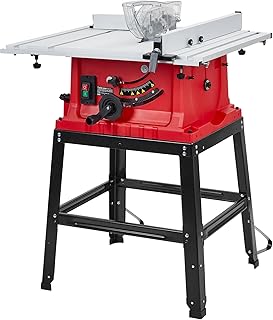
DOVAMAN DTS10A 10″ Table Saw with Stand
The one-side extension wing is the standout feature, adding real support when you’re ripping a 4-foot shelf board solo. Copper motor windings run cooler through sustained hardwood cuts than the aluminum-wound competition, though the miter gauge is worth replacing early.
Table Saw with 98% Dust Collection System
If your shop shares a wall with living space, this enclosed collection design is the strongest argument in the category — it captures the fine particles that matter for your lungs, not just visible chips. Cutting depth tops out around 2.36″, so it suits sheet goods and dimensional lumber rather than heavy timber.
15 Amp 10″ Portable Benchtop Saw with 36T Blade
A capable entry point for DIY furniture making, with 4600 RPM and true 0-45° bevel adjustment in a package light enough to lift onto a workbench alone. Swap the stock 36-tooth blade for a 40T combination blade and the cut quality improves dramatically.
Frequently Asked Questions
Can a sub-$500 table saw handle hardwood?
Yes, with two adjustments: take shallower passes in dense stock like white oak or maple, and use a sharp thin-kerf blade to reduce load on the motor. Feed rate matters more than raw power — push too fast and you’ll stall a 15-amp universal motor on 8/4 material.
Is 8-1/4 inches enough blade for furniture work?
For most casework, yes. An 8-1/4″ saw cuts roughly 2-1/2″ deep, covering 4/4 through 8/4 stock. You’ll only feel the limit on thick tabletop laminations or 4×4 legs, which can be handled in two flipped passes or with a hand saw.
Do I need to upgrade the stock blade?
Almost always. Factory blades are thin-plate 24 to 36 tooth units built to demonstrate the saw runs, not to leave a finish-ready edge. A quality 40T combination blade costs under $50 and is the highest-return upgrade you can make.
How do I check if my new saw is set up correctly?
Unplug it, raise the blade fully, and mark one tooth. Measure from that tooth to the miter slot at the front of the throat plate, rotate it to the back, and measure again. Anything beyond a few thousandths of difference means the trunnions need adjusting before your first cut.
Final Thoughts
For most home furniture builders, the SKIL TS6307-00 hits the best balance — real rip capacity, a fence you can trust, and a stand that makes solo setup painless. If precision matters more than capacity, the DEWALT DWE7485 delivers factory tolerances that punch well above its price, and the DOVAMAN DTS10A earns a look if you want that extension wing for wider panel work.