Key takeaways
- Kerf width vs. saw power: Thin kerf (around .098″) removes less material and lets a 1.5 HP contractor saw pull through hardwood without bogging. Full kerf (1/8″) resists deflection better and suits 3 HP cabinet saws with a matched riving knife or splitter.
- Tooth count and grind: 40 to 50 teeth in an ATB pattern is the sweet spot for mixed work. Some blades add a flat raker tooth in the pattern, which flattens the bottom of a groove — handy if you cut tenon shoulders or rabbets on the saw.
- Plate quality: Look for laser-cut anti-vibration slots and a stated plate thickness. A .071″ plate that runs true beats a thicker sloppy one every time, and expansion slots keep the blade from potato-chipping under heat.
- Carbide and coating: Micrograin carbide holds an edge through more resharpenings. A nonstick or anti-friction coating limits pitch buildup, which matters more than people think — a gummed-up blade burns wood and reads as “dull” long before the carbide is actually spent.
- Arbor fit and RPM rating: Every blade here uses a 5/8″ arbor, standard on 10-inch saws. Confirm the max RPM rating (usually 6,000) exceeds your saw’s no-load speed, and check the plate for a clean, burr-free bore.
Swapping blades every time you move from ripping 8/4 maple to crosscutting a stack of drawer parts gets old fast. Most of us working out of a garage shop have one saw, limited storage, and no interest in re-zeroing a dado stack or fussing with an insert plate mid-project. That’s the whole appeal of a combination blade: a 40-to-50-tooth grind that handles both directions of the grain without leaving you an edge full of tearout to sand away.
The catch is that “combination” covers a wide range of quality. Plate flatness, carbide grade, expansion slots, and kerf width all change how a blade behaves once it heats up and starts to wander. Below are six 10-inch blades worth putting on a cabinet saw or a jobsite saw, with notes on where each one earns its keep and what to check before you buy.
Our top picks




As an Amazon Associate we earn from qualifying purchases at no extra cost to you. Ratings are shown as listed on Amazon.
🛒 Best Price Today on Amazon
Prime members get fast, free shipping on everything above, plus member-only deals. New members get a 30-day free trial — cancel anytime.
How to Choose a/an 10-Inch Combination Table Saw Blade (2026)
- Kerf width vs. saw power: Thin kerf (around .098″) removes less material and lets a 1.5 HP contractor saw pull through hardwood without bogging. Full kerf (1/8″) resists deflection better and suits 3 HP cabinet saws with a matched riving knife or splitter.
- Tooth count and grind: 40 to 50 teeth in an ATB pattern is the sweet spot for mixed work. Some blades add a flat raker tooth in the pattern, which flattens the bottom of a groove — handy if you cut tenon shoulders or rabbets on the saw.
- Plate quality: Look for laser-cut anti-vibration slots and a stated plate thickness. A .071″ plate that runs true beats a thicker sloppy one every time, and expansion slots keep the blade from potato-chipping under heat.
- Carbide and coating: Micrograin carbide holds an edge through more resharpenings. A nonstick or anti-friction coating limits pitch buildup, which matters more than people think — a gummed-up blade burns wood and reads as “dull” long before the carbide is actually spent.
- Arbor fit and RPM rating: Every blade here uses a 5/8″ arbor, standard on 10-inch saws. Confirm the max RPM rating (usually 6,000) exceeds your saw’s no-load speed, and check the plate for a clean, burr-free bore.
The Best 10-Inch Combination Table Saw Blade (2026)s Reviewed
Diablo D1050X 50T Combination Blade
The .098″ thin kerf and Perma-Shield coating make this the easy default for anyone running a portable or contractor saw, since the reduced cutting load keeps the motor from lugging in thick stock. The 15° hook angle feeds aggressively enough for ripping while the ATB grind still leaves a crosscut edge you can glue up straight off the saw.
CMT Orange Tools 256.050.10
CMT’s 15+1 pattern — fifteen ATB teeth followed by a flat raker — is the detail that sets this one apart, since it leaves square-bottomed grooves instead of the scalloped floor a pure ATB blade produces. At .102″ kerf on a .071″ plate it splits the difference between thin and full kerf, and the finish on figured hardwood is genuinely impressive.
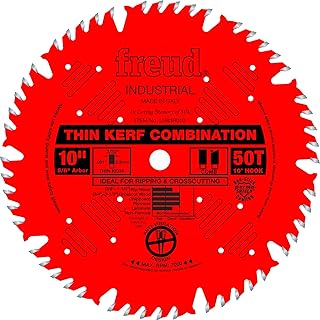
Freud LU83R010 Industrial Thin Kerf
Freud’s TiCo carbide blend is formulated for the mixed demands of a combination grind, and the laser-cut anti-vibration slots keep the plate calm during long rip cuts where heat builds. This is an industrial-line blade that rewards professional sharpening — expect several sharpening cycles before the teeth are used up.
US1048ATBFK 48T Full Kerf
American-made, 48 teeth, and a full 1/8″ kerf, which means real stiffness and minimal deflection when you’re pushing wide panels through a well-tuned cabinet saw. Skip it if your saw is underpowered, but on a 3 HP machine it tracks dead straight.
10-Inch 50T Thin Kerf Combination Blade
A sensible value option with 50 ATB carbide teeth, a nonstick coating to fight resin buildup, and a 6,000 RPM rating. It won’t match the premium plates for vibration control, but for shop jigs, plywood casework, and general breakdown work it cuts cleanly for the money.
Frequently Asked Questions
Can a combination blade replace separate rip and crosscut blades?
For most furniture work, yes. A dedicated 24T rip blade is faster in thick hardwood and an 80T like the FOXBC leaves a cleaner edge on melamine or veneered plywood, but a good 50T combination blade covers 90% of shop tasks without a swap.
Thin kerf or full kerf for my saw?
Under 2 HP, go thin kerf. Above that, full kerf gives you a stiffer plate and straighter cuts. Also check that your splitter or riving knife matches the kerf width — a mismatch causes binding.
How often should I sharpen?
Watch the cut, not the calendar. Burn marks, increased feed pressure, and rising tearout mean it’s time. Clean off pitch with a blade cleaner first, since buildup mimics dullness. Professional sharpening typically runs $20 to $30.
Does tooth count above 50 help on a combination blade?
Not for ripping. High tooth counts remove less material per tooth and generate heat in thick stock, which is why 80T blades are finish-cut specialists rather than all-purpose options.
Final Thoughts
If you’re running a contractor or jobsite saw, the Diablo D1050X delivers the best balance of clean cuts and low motor strain for the price. Woodworkers cutting joinery on the table saw should look hard at the CMT 256.050.10 for its flat raker tooth, while anyone with a 3 HP cabinet saw and a shop full of hardwood will get the straightest cuts from the full-kerf US1048ATBFK.