Key takeaways
- Real duty cycle: Sustained runtime beats headline PSI every time. A dual-cylinder unit rated for 100% duty cycle will fill four tires back-to-back; a single-cylinder budget pump often needs a cooldown after one. Look for the word “continuous” and treat its absence as a warning.
- Battery vs. dual power: Cordless is the whole point, but a 12V DC cord as backup means a dead pack never strands you. If you already own DeWalt or Ryobi packs, an adapter-compatible model saves you carrying yet another proprietary battery.
- Capacity in mAh, not vague claims: Anything under roughly 6,000mAh will manage bike tires and sports balls but struggle across a full set of car tires. Larger 19,200mAh packs add bulk and weight, so match capacity to your actual jobs.
- Auto shut-off accuracy: Set your target pressure, walk away, come back to a properly inflated tire. Test it against a separate stick gauge on day one; a pump that reads 2 PSI high is fine once you know the offset, but you need to know.
- Nozzle and hose quality: The screw-on chuck is the part that fails first. Metal threading, a hose long enough to reach an awkward valve stem, and included Presta and needle adapters separate a tool from a gadget.
Anyone who has wrestled a floor pump into a car trunk at 6am knows the appeal of a handheld inflator. But shopping for one is genuinely confusing: half the listings quote a peak PSI the pump can only hit for three seconds, duty cycles go unmentioned, and battery specs are buried under marketing adjectives. Buy the wrong one and you get a hot, whining plastic brick that stalls out at 28 PSI on a truck tire.
I’ve been putting these through the same rough treatment I give the rest of my shop gear: topping off patio furniture cushions, air mattresses for guests, workshop cart tires, bike commuters, and the occasional low tire on the family sedan. What follows is what actually matters in the spec sheet, honest notes on five strong contenders for 2026, and answers to the questions that come up once the box is open.
Our top picks



As an Amazon Associate we earn from qualifying purchases at no extra cost to you. Ratings are shown as listed on Amazon.
🛒 Best Price Today on Amazon
Prime members get fast, free shipping on everything above, plus member-only deals. New members get a 30-day free trial — cancel anytime.
How to Choose a Handheld Air Compressor (2026)
- Real duty cycle: Sustained runtime beats headline PSI every time. A dual-cylinder unit rated for 100% duty cycle will fill four tires back-to-back; a single-cylinder budget pump often needs a cooldown after one. Look for the word “continuous” and treat its absence as a warning.
- Battery vs. dual power: Cordless is the whole point, but a 12V DC cord as backup means a dead pack never strands you. If you already own DeWalt or Ryobi packs, an adapter-compatible model saves you carrying yet another proprietary battery.
- Capacity in mAh, not vague claims: Anything under roughly 6,000mAh will manage bike tires and sports balls but struggle across a full set of car tires. Larger 19,200mAh packs add bulk and weight, so match capacity to your actual jobs.
- Auto shut-off accuracy: Set your target pressure, walk away, come back to a properly inflated tire. Test it against a separate stick gauge on day one; a pump that reads 2 PSI high is fine once you know the offset, but you need to know.
- Nozzle and hose quality: The screw-on chuck is the part that fails first. Metal threading, a hose long enough to reach an awkward valve stem, and included Presta and needle adapters separate a tool from a gadget.
The Best Handheld Air Compressor (2026)s Reviewed
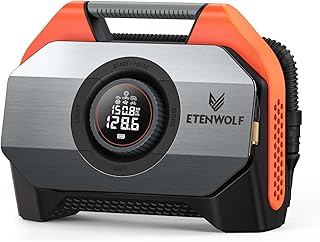
ETENWOLF VORTEX S6 Cordless Tire Inflator
The dual-cylinder design and 19,200mAh pack put this in a different class for anyone inflating truck tires or large inflatables, and the 100% duty cycle means no forced cooldown mid-job. It is the heaviest option here, which you feel in one hand, but the LED backlight and genuine heavy-duty capability earn the extra grams.
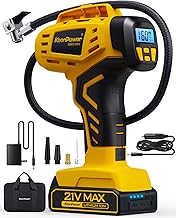
21V Battery Powered 160PSI Tire Inflator
A well-balanced all-rounder: 160 PSI ceiling, digital gauge, auto shut-off, and dual power so a flat battery doesn’t end the session. Inflation speed on car tires is noticeably quicker than older 12V-only pumps, making it the sensible default pick for a household that needs one inflator to cover bikes, balls, and the car.
AstroAI H2 Pro Cordless Tire Inflator
AstroAI’s refined take feels the most polished in hand, with a readable display and a chuck that threads on without cross-threading drama. It’s a smart choice if you value fit and finish and mostly handle passenger tires and inflatables rather than heavy commercial work.
Upgraded 160 PSI 4X Fast Air Pump (DeWalt 20V Compatible)
The killer feature is the adapter that runs it off DeWalt 20V packs you likely already have charged on the shelf. For anyone with an existing DeWalt ecosystem, this eliminates the dead-battery problem entirely and the 4X inflation claim holds up reasonably well on smaller volumes.
AstroAI Cordless 160PSI 12VDC Tire Inflator
The value pick in AstroAI’s lineup, delivering the same auto shut-off and digital gauge fundamentals in a slightly simpler package. Perfectly capable for bikes, mowers, wheelbarrows and topping off car tires, though it wants a rest between full tire fills.
Frequently Asked Questions
Can a handheld inflator fill a completely flat tire?
Yes, but it takes time and taxes the battery. Expect five to nine minutes for a fully flat passenger tire, and choose a dual-cylinder or high-capacity model if this is a realistic scenario for you.
Are these safe for furniture cushions and air mattresses?
Only with the low-pressure needle or cone adapter fitted, and with a close eye on the gauge. High-PSI pumps move air fast enough to overinflate soft goods, so inflate in short bursts rather than setting a target and walking away.
How accurate are the digital gauges?
Most land within 1 to 2 PSI of a quality stick gauge. Check yours once against a known-good reference and simply account for the difference going forward.
How should I store the battery?
Keep it around half charge in a temperature-stable indoor spot, not a freezing or baking garage, and top it up every few months. Storing a fully depleted pack is the fastest way to kill it.
Final Thoughts
For serious sustained work the ETENWOLF VORTEX S6 is the one I’d keep in the shop, while the 21V 160PSI inflator hits the sweet spot for most homes needing a single capable pump. If you already run DeWalt 20V batteries, the DeWalt-compatible upgraded model is the easiest way to add inflation to a kit you’ve already invested in.