Swapping the stock blade off a 12-inch miter saw is the cheapest upgrade in the shop, and most of us learn that the hard way. You cut a nice piece of walnut for a nightstand leg, flip it over, and there it is: a fuzzy, splintered underside that no amount of sanding fully hides. The blade that shipped in the box was built to frame a deck, not to leave a glue-ready face on hardwood trim.
This guide walks through six 12-inch blades worth bolting onto a chop saw or sliding compound saw, from ultra-fine 100-tooth finishers to a thin-kerf general-purpose disc that handles both ripping and crosscuts. I’ve broken down tooth counts, kerf width, grind geometry, and arbor fit so you can match the blade to the work sitting on your bench instead of guessing at the store.
Our top picks



As an Amazon Associate we earn from qualifying purchases at no extra cost to you.
🛒 Best Price Today on Amazon
Prime members get fast, free shipping on everything above, plus member-only deals. New members get a 30-day free trial — cancel anytime.
How to Choose a 12 Blade For Miter Saw (2026)
- Tooth count drives finish: Run 80 to 100 teeth for crosscutting hardwood, plywood, and pre-finished moulding. Drop to 40 or 60 teeth when you need faster feed rates, thicker stock, or the occasional rip cut — high tooth counts bog down and scorch when you push them.
- Arbor and plate flatness: Nearly every 12-inch miter saw uses a 1-inch arbor, so confirm that spec before ordering. Just as important is a laser-cut, tensioned steel plate; a warped body wobbles under load and no tooth grind can rescue a blade that won’t run true.
- Grind geometry: An alternate top bevel (ATB) grind scores both edges of the cut and is what you want for clean crosscuts in solid wood and veneer. Triple-chip and flat-top grinds belong on melamine, laminate, and non-ferrous work, not on your furniture trim.
- Kerf width and saw power: Thin-kerf blades remove less material, which means less strain on smaller motors and a bit less wood wasted per cut. Full-kerf plates resist deflection better on heavy 12-inch saws pushing through 4x stock or stacked pieces.
- Carbide grade and expansion slots: Micrograin carbide tips hold an edge through far more linear feet than budget alloys, and they resharpen cleanly. Look for anti-vibration expansion slots too — they cut noise noticeably and keep the plate stable as it heats up.
The Best 12 Blade For Miter Saw (2026)s Reviewed
100-Tooth ATB TCT Ultra Fine Finish Blade
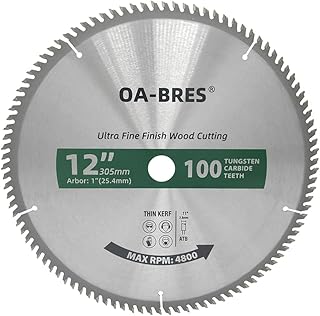
This miter/table saw crossover blade pairs a 100-tooth ATB grind with tungsten carbide tips, and the results on maple and oak are close to planed — I’ve used cuts straight off it for glue-ups without touching a sanding block. Feed slowly and let the tooth count do the work; rushing it in thick hardwood is the one way to get burn marks.
FOXBC 12″ 100-Tooth Polished Finish Blade
FOXBC’s 100-tooth disc is the one I reach for on trim, face frames, and anything pre-finished, where chipout means a wasted board. The polished plate sheds pitch better than most in this price bracket, and the 1-inch arbor drops onto standard 12-inch saws with no shim games.
FOXBC 12″ 80-Tooth Fine Finish Blade
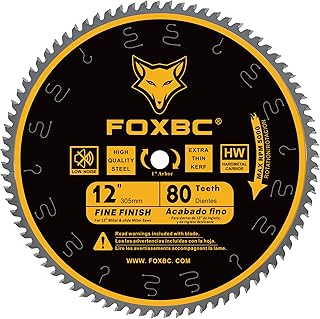
Eighty teeth is the sweet spot if you want a clean crosscut without babying every pass, and this blade clears chips fast enough to run at a normal pace through 3/4″ and 1″ stock. Consider it the daily driver of the FOXBC pair — slightly less refined than the 100-tooth, considerably less fussy.
DEWALT DWA112100 100-Tooth Fine Finish
DEWALT’s tungsten carbide teeth and computer-balanced plate deliver the most consistent cut quality here over the long haul, with vibration low enough that miters close tight on the first try. It costs more than the imports, but the edge retention and resharpenability justify it if the saw earns its keep.
Freud LU86R012 48T Thin Kerf
If one blade has to live on the saw, this is it: 48 teeth and a thin kerf that rips, crosscuts, and handles sheet goods with genuinely respectable results. Freud’s Perma-Shield coating keeps resin from building up, and the reduced kerf is gentle on smaller-amp motors.
Frequently Asked Questions
Is a 100-tooth blade always better than an 80-tooth?
Not for every job. A 100-tooth blade produces a finer surface, but each tooth removes less material, so it heats up and burns in thick or resinous stock. Eighty teeth handles a broader range of thicknesses with almost the same finish.
Do I need a 1-inch arbor blade?
Almost certainly yes — virtually all 12-inch miter saws use a 1-inch arbor. Check your manual or measure the shaft before buying, since reducer bushings on a miter saw introduce runout you don’t want.
Can I use a miter saw blade on my table saw?
Some blades, like the 100-tooth ATB TCT model here, are rated for both. Verify that the maximum RPM matches your saw and that the hook angle isn’t aggressively positive, which can cause grabbing on a table saw.
How often should a fine-finish blade be sharpened?
For hobby use, once or twice a year is typical. Watch for the symptoms instead of the calendar: increased feed pressure, burning, or fuzz on the exit face all mean the carbide is dull.
Final Thoughts
For the cleanest possible crosscut on furniture-grade hardwood, the DEWALT DWA112100 is the blade I’d buy first — its balance and edge life stay consistent long after budget discs start burning. The FOXBC 80-tooth is the smarter everyday pick for mixed shop work, and the Freud LU86R012 thin kerf earns a permanent spot if you want one blade that does nearly everything well.