Air compressors are the tool nobody thinks about until they need one, and then they need one badly. Maybe you’re assembling a bed frame and want a brad nailer to tack the trim instead of hand-driving finish nails into hardwood. Maybe you’re refinishing a dining table and a spray gun would lay down a finish no brush can match. The trouble is that shopping for a compressor drops you into a spec sheet swamp: CFM, PSI, duty cycle, single-stage versus two-stage, oil-free versus oil-lubed. Buy on tank size alone and you’ll end up with a big red tank that can’t keep a nailer fed.
This guide skips the marketing copy and looks at what actually matters when you’re standing in a garage or a spare bedroom trying to get work done. We’ve grouped picks by the jobs home furniture makers really do: quick inflation runs, trim and cabinet work, occasional spraying, and the heavier shop setups where you’re running tools for hours. Below you’ll find the brands worth your money in 2026, what each one does well, and where the tradeoffs hide.
Our top picks



As an Amazon Associate we earn from qualifying purchases at no extra cost to you.
🛒 Best Price Today on Amazon
Prime members get fast, free shipping on everything above, plus member-only deals. New members get a 30-day free trial — cancel anytime.
How to Choose a/an Air Compressor Brands (2026)
- Start with CFM, not gallons: Your tools have an air appetite measured in CFM at 90 PSI. A brad nailer sips around 0.3 CFM; an HVLP spray gun can gulp 6 or more. Add up your thirstiest tool, pad it by 30%, and shop from that number. Tank size only determines how long you go before the motor kicks back on.
- Match the pump to your duty cycle: Popping a few nails means the pump rests between bursts. Sanding a tabletop with a pneumatic orbital means it runs almost nonstop. Continuous work calls for a cast-iron, oil-lubricated pump; intermittent work is fine on oil-free aluminum.
- Think hard about noise: A pancake compressor in a finished basement will get you yelled at. Anything under 70 dB is livable indoors. Louder units belong in a detached garage, or you plan around them with a long hose and closed door.
- Check your outlet before your cart: Most portables run happily on a 15-amp 120V circuit. Once you climb past 3 HP, you’re looking at 240V and a dedicated breaker, which means an electrician and a bill that rivals the compressor.
- Be honest about portability: A 26-gallon vertical rolls fine on a smooth floor and fights you on stairs. If your projects move between the garage, driveway, and a second-floor room, weight and wheel quality matter more than the extra couple of gallons.
The Best Air Compressor Brands (2026)s Reviewed
DEWALT Pancake Air Compressor, 6 Gallon (DWFP55126)
This is the default recommendation for furniture and trim work, and deservedly so: 2.6 SCFM at 90 PSI keeps a brad nailer or finish nailer running without stalling, and the oil-free pump means no maintenance ritual between projects. It’s the compressor you buy once and stop thinking about.
Metabo HPT 6 Gallon Pancake, 200 PSI (EC914S)
The 200 PSI ceiling and 4 CFM flow rate let this pancake feed two nailers at once, which matters when you’ve got a helper or you’re switching between a framing gun and a brad gun mid-build. Higher tank pressure also means more usable air per fill, so the motor cycles less often on a long session.
Craftsman 26 Gallon Portable (CMXECXA3332643)
At 5.0 CFM at 90 PSI, this is where a home shop crosses from nailers-only into spraying and pneumatic sanding territory. The oil-free induction motor is quieter and longer-lived than the universal motors on cheaper vertical tanks, and it still plugs into a standard outlet.
Ingersoll Rand 2340N5-V 5 HP Two-Stage
This is a serious piece of shop equipment: 14.3 CFM at 90 PSI from a cast-iron two-stage pump on an 80-gallon tank, built to run all day without complaint. You’ll need 240V wiring and floor space, but nothing else here comes close for a dedicated woodworking shop.
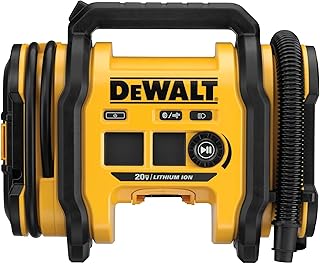
DEWALT 20V MAX Tire Inflator (DCC020IB)
Not a shop compressor, and it doesn’t pretend to be. What it does well is top off tires, inflate air mattresses for guests, and handle low-pressure jobs on battery power, with automatic shutoff so you can walk away mid-fill.
Frequently Asked Questions
Can I run a spray gun on a 6-gallon pancake compressor?
An airbrush or a small detail gun, yes. A full-size HVLP gun spraying a tabletop, no. Those need 6 to 12 CFM sustained, which means a 20-gallon-plus tank and a pump rated to match. Trying it anyway gives you an orange-peel finish and a compressor that never stops running.
Oil-free or oil-lubricated?
Oil-free wins for anyone using a compressor a few hours a month: no oil changes, no leaks, works in any orientation. Oil-lubricated pumps run cooler, quieter, and last several times longer under heavy use, which is why every serious shop compressor uses one.
What size hose should I use?
A 3/8-inch inner diameter hose for anything demanding, and keep it under 50 feet. Quarter-inch hose chokes airflow enough to starve a sander or spray gun, and every extra coil of length costs you pressure at the tool.
Does a cordless inflator replace a real compressor?
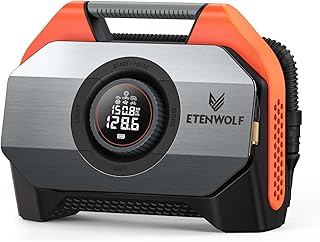
No. Battery inflators like the ETENWOLF VORTEX S6 and the DEWALT DCC020IB move small volumes of air at high pressure, which is perfect for tires and inflatables and useless for running pneumatic tools. They’re a complement, not a substitute.
Final Thoughts
For most people building or refinishing furniture at home, the DEWALT DWFP55126 pancake is the right buy: quiet enough for indoor work, enough air for every nailer you’ll own, and zero maintenance. Step up to the Craftsman 26-gallon if spraying and pneumatic sanding are in your plans, and reach for the Ingersoll Rand 2340N5-V only when you’ve got a dedicated shop with 240V power and work that justifies a cast-iron two-stage pump.