Food stuck on clean plates may mean the filter at the bottom of your dishwasher is overdue for attention. Learning how to clean dishwasher filter parts is usually a straightforward household task: find the removable assembly, rinse away debris, then seat it correctly before the next cycle. On a typical user-serviceable model, allow roughly 10 to 20 minutes, longer if you need to find the manual or clear stubborn residue. Some dishwashers have self-cleaning filters that should not be taken apart.
Quick Answer: Let the appliance stop and cool, disconnect its power, and pull out the lower rack. Follow your model’s manual to release the filter, gently wash the parts with warm water, and reinstall them until they lock. Never force a filter mechanism or run a cycle with the assembly missing.
As an Amazon Associate we earn from qualifying purchases.
By DIY Ideas 4 Home Editorial Team
Before You Start: Tools, Materials and Safety
Whirlpool’s U.S. filter-cleaning instructions and Bosch’s owner support both emphasize running water and gentle cleaning rather than abrasive scraping. The exact removal mechanism matters more than the cleaning product: a filter that looks removable may be retained by tabs, posts or a hidden locking ring. Gather supplies only after checking the dishwasher’s model number and Use and Care guide.
| Tool or Material | Size or Spec | Why You Need It | Substitute |
|---|---|---|---|
| Warm running water | Comfortably warm, not boiling | Flushes loose food from the screen and housing | Basin of clean warm water |
| Nonabrasive sponge | Soft, clean surface | Wipes fine mesh without scouring it | Soft cloth approved by your manual |
| Mild dish soap | Small amount in warm water | Loosens greasy film when the maker permits soap | Water alone for light debris |
| Small cleaning brush | Soft bristles only where permitted | Reaches ridges on sturdier plastic pieces | Old soft toothbrush, if approved |
| Shallow tray and towel | Large enough for filter pieces | Keeps parts together and controls drips | Clean baking sheet and cloth |
| Model-specific manual | Exact model and revision | Shows release direction and reassembly order | Manufacturer’s official online guide |
Identify the Filter System Before Removing Anything
Open the door and look at the floor of the tub, usually beneath the lower rack and near the spray arm. A removable assembly may include a cylindrical microfilter and a flat lower mesh screen, but names and shapes differ. GE Appliances’ guide, Dishwasher – How to Clean Fine and Ultra Fine Filters, states that several older and some current GE dishwashers instead use self-cleaning filtration with no routine filter removal.
Look up the appliance by its full model number, not simply its brand. On a built-in machine, the identification label is often on a door edge or tub frame; on a countertop dishwasher, check the rating label or instruction booklet. If the manual says the filter is maintenance-free, clean only the user-accessible area it identifies and leave the internal assembly in place.
Keep Hands Away From Electricity and Sharp Debris
Allow the cycle to finish, then wait until hot interior surfaces and wash water have cooled. Disconnect a plug-in model before touching the sump area; for a hardwired model, turn off the appropriate circuit breaker if the owner’s instructions require electrical isolation. Do not open control panels or remove wiring covers as part of routine filter care.
Wear gloves if you suspect broken glass or metal fragments around the filter basket, and use a cloth or appropriate tool instead of blindly putting your fingertips into a hidden cavity. If pooled water prevents you from seeing the filter, consult the model instructions before removing it. Filter cleaning is a maintenance task, not a reason to dismantle the pump or drain plumbing.
Know When a Simple Cleaning Is Not Enough
Stop if the filter is seized, its locking handle is cracked, or the screen has a torn section. A missing piece can let food enter areas the filter is meant to protect. GE’s guidance describes a separate retaining arrangement on some of its fine filters, so pulling upward on an apparently immovable mesh plate could damage the tabs rather than loosen the part.
If the owner manual directs you to a service technician for the filter housing, follow that instruction. Water continuously collecting after a completed cycle may have causes elsewhere in the drain path; our separate guide to a dishwasher that will not drain covers those checks. Here the goal is to remove and clean only the filter parts the manufacturer designates as user-serviceable.
How to Clean a Dishwasher Filter Step by Step
A filter should go back into the machine in the reverse order of removal, with every retaining point secured. Whirlpool’s filter instructions warn against starting a wash when the upper assembly is not locked because parts may be damaged. The following seven-step method covers removable household filters while calling out designs that need a different technique.
Step 1: Empty the Lower Rack and Expose the Filter
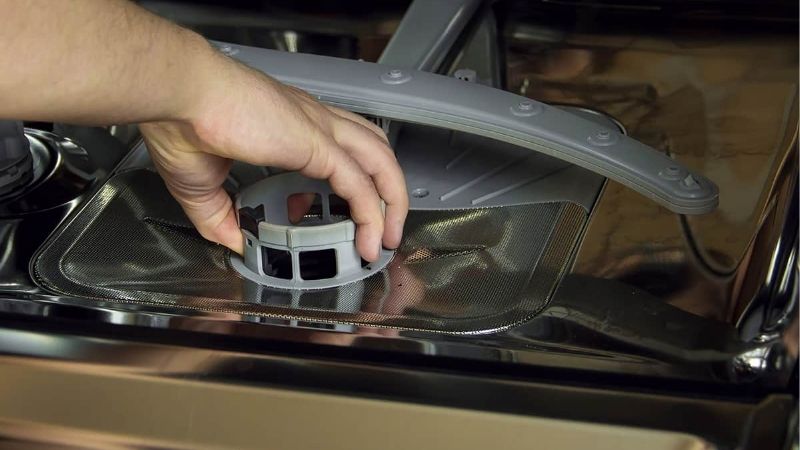
Take dishes and utensils out of the lower rack, slide the rack forward and lift it clear if your model allows. Use a flashlight to find the filter handle or central cylindrical screen. The Whirlpool and Bosch U.S. cleaning guides both locate serviceable filters at the bottom of the dishwasher, though the exact position can differ from one tub to another.
Put the rack somewhere safe so its wheels and sharp edges cannot scratch the floor. Take a quick photograph of the filter before touching it, including any printed arrows or locking marks. This gives you a reference when the small plastic pieces must be fitted back together. If the spray arm blocks access, remove it only if your specific manual instructs you to do so.
Step 2: Check the Locking Direction
Look for a lever, twist handle or removable insert and compare it with the manual illustration. Whirlpool’s Product Help page, How to Clean the Dishwasher Filters, directs owners of the illustrated two-part design to rotate the upper filter one-quarter turn counterclockwise before lifting it. Bosch describes a leftward rotation on its illustrated removable systems. These instructions do not establish a universal direction for every dishwasher.
Do not apply extra force if the filter resists. Recheck the retaining tabs and whether the lower screen is held by an additional fastener. On particular GE fine-filter systems, GE Appliances specifies two separate retaining posts that must be released before the flat screen comes out. A gentle movement following the correct diagram should be enough; resistance usually means a locking point remains engaged.
Step 3: Remove the User-Serviceable Pieces
Lift the released cylindrical filter straight out and set it in a clean tray. If your dishwasher has a second removable flat screen, take it out in the order specified for that model, noting which edge sits under a tab. Keep any removable collars together so they do not roll into the sink. Do not pry up the floor of the tub or remove screws unrelated to the identified filter components.
Inspect the exposed recess without reaching beyond the accessible opening. Large bits of pasta, paper labels or stray utensils can lodge near the screen and may be picked up carefully once the machine is safe and the debris is visible. If you discover sharp fragments or a loose pump cover, stop and consult the manual; those conditions call for more caution than an ordinary rinse.
Step 4: Knock Off Debris Without Forcing It Through
Tip scraps into the trash before bringing the filter to the sink. This reduces the chance of putting the same food residue down a household drain and makes the fine mesh easier to inspect. If the parts have an inner coarse basket and outer microfilter, separate them only where the manufacturer’s guide explicitly shows that joint.
Turn each approved removable piece slowly while looking for grease around the seams. Use gloved fingers or a damp sponge to lift larger food particles away from the screen rather than grinding them into the openings. Check both sides and avoid pushing a toothpick, metal skewer or knife through mesh perforations. Distorted holes may leave the filter unable to capture particles on later washes.
Step 5: Rinse and Gently Clean Each Filter Surface
Hold the filter under comfortably warm running water and rinse from the side that best dislodges the trapped material. Add a little mild dish soap when the manual permits it, then work through grooves with a soft sponge. Bosch’s U.S. dishwasher filter guide calls for running water, mild soap and a soft brush; Whirlpool also permits a soft brush on stubborn deposits, but neither recommends wire bristles or abrasive scouring pads.
There is an important exception for delicate filter types. GE Appliances’ instructions for its Ultra Fine Filter recommend warm, soapy water and a sponge and warn that brushes can damage this particular screen. On the separate GE Fine Filter, gentle brushing may be permitted for stubborn soil. Let the specific part’s material and written instructions decide whether a brush is suitable, even if a brush works on a different brand’s filter.
Rinse until visible detergent film and loose particles are gone, then examine the screen against a light source. If holes remain visibly blocked, repeat the gentle rinse rather than soaking the filter in harsh chemicals or scraping it with a sharp object. Strong acids, bleach and drain openers are not routine filter-cleaning tools. A descaler for the whole dishwasher, where approved, serves a different purpose from hand-washing the removable screen.
Step 6: Check for Damage and Reinstall the Parts
Look for cracked edges, bent screen material and a worn locking ring before putting the pieces back. Return the lower mesh first where that is how your owner’s manual illustrates the assembly. Align tabs, seat the upper cartridge and turn it in the specified locking direction until it stops at its proper position. Whirlpool’s filter support specifically warns that an upper assembly that still rotates freely is not properly locked.
Run a fingertip around the accessible perimeter to confirm that the filter sits level with the surrounding housing. Do not force the ring past its stop, and do not replace the bottom rack until the filter is secure. If a retaining tab has broken, order a part matched to the exact dishwasher model rather than placing a loose screen back in the tub. The Bosch replacement-parts finder uses the appliance’s E-Nr. model identifier to check fit.
Step 7: Restore Power and Check the Next Cycle
Slide the lower rack back along its tracks, ensure the spray arm can turn without hitting the rack, and restore power if it was disconnected. Choose a short rinse or other manufacturer-approved test cycle. Listen for normal filling and pumping, then inspect the clean dishes or tub floor after the test for displaced debris. A properly seated filter should stay locked and should not rattle loose during ordinary operation.
Do not conclude that a filter cleaning solved a broader drainage problem merely because the visible screen now looks clean. If water continues to stand unusually high after a cycle, or a drain error keeps returning, stop testing repeatedly and use the model’s troubleshooting chart. Whirlpool and Bosch both describe separate hose, sump and pump problems that filter washing alone cannot correct. Those issues call for a targeted diagnosis rather than more aggressive scrubbing.
Products That Help
The OXO Good Grips Deep Clean Brush Set 1351280 contains two nylon-bristle brushes, including a smaller head for narrow spaces; OXO’s U.S. product page listed the set at $9.99 as of October 2026. It can help clean accessible plastic ridges when the dishwasher manufacturer allows soft brush cleaning. Do not use it on a delicate GE ultra-fine mesh or another filter that specifically requires a sponge; ordinary water and a nonabrasive sponge are often all you need.
If the screen is cracked rather than dirty, consider a manufacturer-matched replacement such as the Bosch Coarse Filter and Micro-Filter 00645038, listed by Bosch U.S. at $35.99 as of October 2026. Bosch identifies it as replacing part 00651097 and provides an E-Nr. compatibility checker. Buy this filter only after confirming the exact appliance model; it is an example of a genuine replacement part, not a universal fit for Bosch, Whirlpool, GE or other dishwashers.
Common Mistakes That Can Undo the Cleaning
The most damaging shortcut is forcing a stuck filter handle. A locked assembly can look like it should lift straight out, and a fragile plastic collar may snap when pried. Another mistake is washing a fine screen with the same abrasive pad used for baked-on cookware. The screen is meant to catch tiny fragments; a torn or stretched section defeats that purpose even if the rest looks spotless.
Skipping the reinstallation check is equally avoidable. Confirm that the filter is seated before loading the rack, especially on a two-part design with a flat base and a separate cartridge. Keep a simple reminder based on how the machine is used: Bosch’s U.S. how-to guidance says every few months on its models, and monthly if you have hard water. GE Appliances suggests inspecting its fine and ultra-fine filters about every other month, more often when cleaning performance declines.
Whirlpool’s published schedule illustrates why a single interval does not work for every household. For an example of four to seven dishwasher loads each week with dishes loaded without scraping or rinsing, Whirlpool suggests monthly cleaning; for eight to twelve similarly dirty loads, it lists every two weeks. Use these as maker-specific reference points, not a requirement to pre-rinse dishes or a calendar that overrides your own model’s manual.
Frequently Asked Questions
After the filter is clean, the remaining questions usually concern daily loading habits and whether the filter needs special maintenance between cleanings. The answers below focus on those related decisions rather than repeating the removal sequence.
Should I Rinse Plates Before Loading the Dishwasher?
No, a full pre-rinse is not normally needed on a dishwasher designed to handle ordinary food soils. Bosch’s U.S. cleaning-performance guide advises scraping food from plates while skipping the full rinse. Remove bones, labels and large scraps before loading, then follow the cleaning interval recommended for your appliance and the amount of residue you leave behind.
If your household routinely loads very dirty dishes, inspect the screen more often rather than assuming the filter can handle unlimited scraps. Frequent pre-rinsing also uses extra water without necessarily improving the wash result, so use the loading guidance in the owner’s manual.
Does a Dishwasher Cleaner Tablet Clean the Filter Too?
No, an interior cleaning tablet should not be treated as a replacement for removing and washing a user-serviceable filter. Whirlpool’s dishwasher-care guidance treats filter clearing as a separate task from running a machine-cleaning cycle. Cleaner tablets are designed to address buildup elsewhere in the wash system when used according to the product and dishwasher directions.
Use only cleaning products that the appliance maker permits, and never combine bleach, acids or other cleaners. If the filter mesh has trapped visible food, the most direct correction is to lift that debris out and rinse the screen by hand.
Why Does the Dishwasher Still Smell After Cleaning the Filter?
Odor can remain because the filter is only one place where food residue collects. Inspect the door gasket, detergent area and accessible spray-arm surfaces according to the owner’s manual, and verify that the next normal cycle drains as expected. A stale smell with standing water may point to a drainage issue rather than a filter that needs harder scrubbing.
If the smell resembles burning insulation or another electrical fault, stop using the machine and arrange service instead of experimenting with cleaners. An authorized technician is also appropriate if the filter housing cannot be removed or refitted as the manual specifies.
Can I Wash a Removable Filter in the Dishwasher?
Only if the exact model’s manual explicitly allows that method. The Whirlpool, Bosch and GE filter-care instructions reviewed for this guide describe hand-cleaning with running water, and a wash cycle can leave the screen in an unsuitable position or expose delicate parts to detergent and heat. Hand washing also lets you inspect small cracks before the filter is put back.
If a part is too clogged to rinse with gentle soap and water, check the manufacturer for the proper replacement rather than treating a high-temperature cycle as a repair. Match the part number to the appliance model before ordering.
Final Thoughts
The useful habit after learning how to clean dishwasher filter parts is saving a photograph of the correctly locked assembly alongside your appliance’s model number. That small record makes the next cleaning less dependent on guesswork, especially if your household has more than one dishwasher design. Start with a gentle rinse, confirm the filter is secure, and replace a damaged screen only with a part the manufacturer identifies as compatible.