Key takeaways
- Blade diameter vs. real capacity: A 10-inch saw handles most furniture stock — 2x material, 1x boards up to about 5.5 inches wide. Go 12-inch if you regularly crosscut wide panels, stair treads, or 6-inch aprons. Sliding models add reach without jumping blade size, which keeps replacement blades cheaper.
- Single vs. double bevel: Single bevel tilts one direction, so you flip the workpiece for the mirrored cut. That’s fine for occasional work. Double bevel matters when you’re cutting crown, cabinet cornice, or angled leg assemblies where flipping a long board isn’t practical or introduces error.
- Cut line accuracy: Laser lines shift with blade deflection and battery voltage. Shadow-based systems project the blade’s actual silhouette, which means the line moves with the kerf and stays honest. If you work to layout marks rather than a stop block, this is the feature that pays for itself.
- Detents and fence squareness: Check that positive stops land firmly at 0, 15, 22.5, 31.6, and 45 degrees, and that the fence is tall enough to support crown or wide stock vertically. Plan on squaring the fence and blade with a machinist square out of the box regardless of brand.
- Dust collection and shop footprint: No miter saw captures fine dust well, but a shroud that funnels chips toward a 2.5-inch port will keep your bench workable with a shop vac attached. Sliding saws need rear clearance for the rails, so measure your wall before you buy one.
Every furniture project eventually runs into the same wall: a joint that should close tight but doesn’t. You cut a 45, you cut its mate, and the mitered corner shows daylight. Nine times out of ten the blade wasn’t the problem and neither was your measuring — it was a saw that couldn’t hold an angle under load, or a detent plate that drifted a half-degree when you leaned into the handle. That gap is where a lot of otherwise good builds fall apart, especially on face frames, picture-frame tabletops, and anything with visible end grain.
This guide is written from the bench, not the spec sheet. I’ve laid out what actually matters when you’re cutting hardwood for furniture rather than framing lumber — crosscut capacity for wide aprons, bevel range for compound angles on tapered legs, and whether the cut line indicator is trustworthy enough to work to a pencil mark. Below you’ll find the compound miter saws worth your money in 2026, followed by a buying framework and answers to the questions that come up most often in the shop.
Our top picks



As an Amazon Associate we earn from qualifying purchases at no extra cost to you. Ratings are shown as listed on Amazon.
🛒 Best Price Today on Amazon
Prime members get fast, free shipping on everything above, plus member-only deals. New members get a 30-day free trial — cancel anytime.
How to Choose a Compound Miter Saw (2026)
- Blade diameter vs. real capacity: A 10-inch saw handles most furniture stock — 2x material, 1x boards up to about 5.5 inches wide. Go 12-inch if you regularly crosscut wide panels, stair treads, or 6-inch aprons. Sliding models add reach without jumping blade size, which keeps replacement blades cheaper.
- Single vs. double bevel: Single bevel tilts one direction, so you flip the workpiece for the mirrored cut. That’s fine for occasional work. Double bevel matters when you’re cutting crown, cabinet cornice, or angled leg assemblies where flipping a long board isn’t practical or introduces error.
- Cut line accuracy: Laser lines shift with blade deflection and battery voltage. Shadow-based systems project the blade’s actual silhouette, which means the line moves with the kerf and stays honest. If you work to layout marks rather than a stop block, this is the feature that pays for itself.
- Detents and fence squareness: Check that positive stops land firmly at 0, 15, 22.5, 31.6, and 45 degrees, and that the fence is tall enough to support crown or wide stock vertically. Plan on squaring the fence and blade with a machinist square out of the box regardless of brand.
- Dust collection and shop footprint: No miter saw captures fine dust well, but a shroud that funnels chips toward a 2.5-inch port will keep your bench workable with a shop vac attached. Sliding saws need rear clearance for the rails, so measure your wall before you buy one.
The Best Compound Miter Saw (2026)s Reviewed
DEWALT DWS713 10-Inch Single Bevel Compound
This is the saw I’d hand a first-time furniture builder: light enough to move between a garage bench and a job site, with a 15-amp motor that doesn’t bog in maple. Capacity tops out around 2×6 crosscuts, so it’s ideal for chair parts, drawer stock, and trim rather than wide slabs.
DEWALT DWS715 12-Inch Single Bevel Compound
Same straightforward chop-saw layout as the DWS713 but with the larger blade, which buys you noticeably more vertical capacity against the fence — useful for baseboard and taller casework parts. It’s a strong value if you want 12-inch reach without paying for slide rails you may not need.
DEWALT DWS780 12-Inch Double Bevel Sliding
The XPS shadow light is the reason to choose this one; it casts the blade’s own shadow on your layout line and never needs calibration. Combined with double bevel and a 13-inch crosscut at 90 degrees, it handles tabletop breadboard ends and mitered casework without workarounds.
DEWALT DWS779 12-Inch Double Bevel Sliding
Mechanically close to the DWS780 minus the shadow light, running the same 3,800 RPM 15-amp motor and generous crosscut capacity. If you cut mostly to stop blocks and fences, the savings are real and the cut quality is identical.
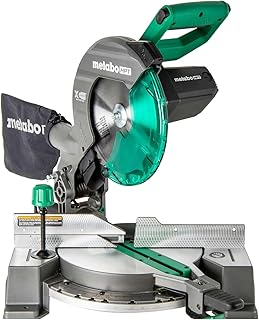
Metabo HPT C10FCG2 10-Inch Single Bevel
At roughly 24 pounds this is the easiest saw here to lift onto a stand solo, and the Xact Cut shadow line is unusual at this price. The included 40-tooth carbide blade cuts cleanly enough for painted work, though I’d upgrade to an 80-tooth for hardwood miters.
Frequently Asked Questions
Do I need a sliding saw for furniture work?
Only if you crosscut stock wider than about six inches regularly. Many furniture makers break down wide panels on a track saw or table saw and use the miter saw purely for angles and repeat lengths, where a non-sliding chop saw is stiffer and more accurate.
Is 10-inch or 12-inch better?
Ten-inch blades run at higher rim speed with less deflection, giving marginally cleaner cuts and cheaper blade replacement. Twelve-inch wins on capacity. For cabinet and furniture parts, 10-inch is usually the smarter choice.
How often should I check calibration?
Verify blade-to-fence square and bevel zero after any transport, and spot-check monthly with a reliable square. A five-minute check prevents an afternoon of mystery gaps.
What blade should I use for hardwood miters?
A thin-kerf 80-tooth ATB carbide blade for a 10-inch saw, or 80 to 96 teeth on a 12-inch. Fewer teeth cut faster but tear out on end grain, which is exactly where furniture joints show.
Final Thoughts
For most home furniture shops, the DEWALT DWS780 is the saw to buy once — the shadow light and double bevel remove guesswork from compound angles, and the capacity covers everything short of slab work. If your budget is tighter, the DWS779 delivers the same cuts for less, and the Metabo HPT C10FCG2 is the pick for anyone who needs a genuinely portable, accurate 10-inch saw without spending much.