Key takeaways
- Slot fit and play adjustment: Nearly every consumer saw uses a 3/4″ x 3/8″ T-slot, but tolerances vary between brands. Look for a bar with adjustable nylon or set-screw expanders so you can dial out side-to-side wobble without the bar binding as the cast iron warms up.
- Fence length versus your shop: A fixed 18″ fence handles rails, stiles, and drawer sides comfortably. Extendable fences reaching 32″ or 38″ pay off if you crosscut wide panels or shelf stock, but they need clearance behind the saw — measure before you commit.
- Flip stop quality: The stop is what makes repeat cuts identical. A stop with micro-adjust lets you creep up on a length by thousandths instead of loosening, nudging, and re-clamping. Flip-away action matters too, since you need it out of the way to avoid trapping offcuts.
- Angle stop count and design: Positive stops at common angles (90, 45, 22.5) beat squinting at a scale. More detents means less setup time on segmented or polygonal work. Spring-loaded plungers seat faster than drop-pin designs but check that they lock firmly.
- Material and mass: Extruded aluminum fences with anodized T-track resist dings and stay flat. Skip anything with a stamped-steel head — the extra heft in a machined aluminum body genuinely steadies the cut.
What's inside
The stock miter gauge that shipped with your table saw is almost certainly the weakest link in your shop. Mine had about a millimeter of slop in the slot, a stamped protractor scale you could barely read under shop lights, and a fence so short that anything wider than a picture frame rail wanted to pivot mid-cut. You end up chasing gaps in your joinery and blaming your technique, when the real culprit is a $12 accessory bolted to a $600 machine.
An aftermarket miter gauge fixes that for less than the cost of a decent router bit set. This guide walks through what actually matters when you upgrade — bar fit, fence length, stop repeatability, and angle detents — then breaks down the models worth your money in 2026. Everything below is judged on how it performs building real furniture: face frames, aprons, drawer parts, and the occasional compound-angle chair leg that makes you question your life choices.
As an Amazon Associate we earn from qualifying purchases.


🛒 Best Price Today on Amazon
Prime members get fast, free shipping on everything above, plus member-only deals. New members get a 30-day free trial — cancel anytime.
How to Choose a/an Miter Gauge Table Saw (2026)
- Slot fit and play adjustment: Nearly every consumer saw uses a 3/4″ x 3/8″ T-slot, but tolerances vary between brands. Look for a bar with adjustable nylon or set-screw expanders so you can dial out side-to-side wobble without the bar binding as the cast iron warms up.
- Fence length versus your shop: A fixed 18″ fence handles rails, stiles, and drawer sides comfortably. Extendable fences reaching 32″ or 38″ pay off if you crosscut wide panels or shelf stock, but they need clearance behind the saw — measure before you commit.
- Flip stop quality: The stop is what makes repeat cuts identical. A stop with micro-adjust lets you creep up on a length by thousandths instead of loosening, nudging, and re-clamping. Flip-away action matters too, since you need it out of the way to avoid trapping offcuts.
- Angle stop count and design: Positive stops at common angles (90, 45, 22.5) beat squinting at a scale. More detents means less setup time on segmented or polygonal work. Spring-loaded plungers seat faster than drop-pin designs but check that they lock firmly.
- Material and mass: Extruded aluminum fences with anodized T-track resist dings and stay flat. Skip anything with a stamped-steel head — the extra heft in a machined aluminum body genuinely steadies the cut.
The Best Miter Gauge Table Saw (2026)s Reviewed
O’SKOOL PTA026 Miter Gauge with 22–36″ Extension Fence
This is the one I reach for on cabinet work: 27 positive angle stops, a fence that reverses for narrow stock or wide panels, and a zero-play fit adjustment that actually holds after a season of use. The 22 to 36 inch range covers shelf crosscuts most gauges can’t touch, and the flip stop returns to the same spot cut after cut.
GOINGMAKE Miter Gauge with 21–38″ Long Extendable Fence
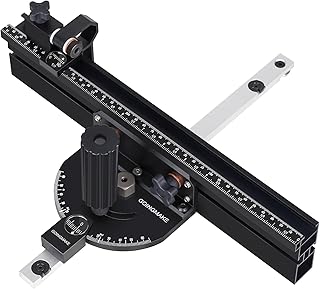
If you build casework and hate walking to the miter saw for wide crosscuts, this is the long-reach option. Micro-adjust on the flip stop makes fine-tuning drawer front lengths painless, and the 13 angle stop holes hit the angles furniture work actually calls for.
GOINGMAKE Miter Gauge with Micro Adjust Flip Stop and 18–32″ Fence
The best balance in the lineup — enough extension for most furniture parts without a fence that overhangs your outfeed. The micro-adjust mechanism is the standout feature here, letting you sneak a tenon shoulder into place without any guesswork.
VEVOR Precision Miter Gauge, 19–35″ with Removable Disc
The spring-loaded plunger snaps into its 15 angle stops decisively, and the removable disc is genuinely useful when you need an odd angle off the scale. Solid aluminum alloy construction at a price that undercuts most of the competition.
GOINGMAKE Compact Miter Gauge with 360mm Fence
For small shops and hobby saws, the compact 360mm fence keeps things manageable while still adding the positive angle stops and flip stop your factory gauge lacked. A smart pick if you mostly cut frame stock and small components.
Frequently Asked Questions
Will these fit my saw?
All the models here are built for the standard 3/4″ x 3/8″ T-slot found on most jobsite and cabinet saws from DeWalt, SawStop, Bosch, Delta, and Ridgid. Measure your slot width and depth first — a handful of older or import saws use non-standard dimensions.
Do I still need a crosscut sled?
A good miter gauge handles the majority of crosscuts and all your angled cuts. A sled still wins for very wide panels and repeated identical parts where zero-clearance support matters, but a quality gauge covers 80% of the work in far less setup time.
How do I check the gauge for square?
Ignore the printed scale. Set the gauge to 90, make a test cut on scrap about 6″ wide, flip one half over, and butt the cut edges together against a straightedge. Any gap is double your error — adjust the 90-degree stop and repeat.
Is micro-adjust worth paying for?
Yes, if you cut joinery. Being able to move a stop a few thousandths without loosening the clamp is the difference between a tenon that fits and one you have to pare by hand.
Final Thoughts
For most furniture builders, the O’SKOOL PTA026 is the strongest all-around upgrade — the reversible fence, 27 detents, and zero-play adjustment make it feel like shop equipment rather than an accessory. If your work runs wide, the GOINGMAKE 21–38″ long-fence model gives you crosscut capacity a sled would otherwise handle, and the VEVOR Precision Miter Gauge delivers most of the same accuracy for less if you’re building out a first shop.