Key takeaways
- Low-end spindle speed: This is the single spec that separates a metal press from a wood press. Mild steel wants 300–600 RPM with a standard twist bit, and larger holes want slower still. A press whose bottom speed is 740 RPM will burn bits on anything over 3/8″. Check the slowest setting before you check the top one.
- Cast iron mass: Weight is not a downside here, it is the feature. A cast iron head, column, and table soak up the vibration that makes bits wander and holes go oval. Stamped-steel bases flex under feed pressure and you will feel it as chatter in the handles.
- Quill travel and throat depth: Quill travel sets how thick a piece you can drill in one plunge — 2″ to 3.2″ covers most flat bar and tube work. Throat depth (half the swing) determines how far from an edge you can reach, which matters when you are putting bolt holes through the middle of a table apron.
- Chuck capacity and runout: A 1/2″ or 5/8″ keyed chuck handles the bit sizes metalwork demands. Keyless chucks slip under the torque of a big bit in steel. Cheap chucks with visible runout will oversize every hole you drill.
- Fixed column vs. magnetic: If the steel comes to the tool, a benchtop press wins. If the tool has to go to the steel — a welded base already tacked together, a beam, an installed frame — a magnetic drill is the only option that works.
What's inside
Drilling steel is where most benchtop presses get exposed. A press that chews through pine at 3,000 RPM will work-harden a piece of mild steel plate in seconds, leave a bruised crater instead of a hole, and dull a fresh cobalt bit before you finish one pass. The problem is that metal wants the opposite of what wood wants: slow spindle speeds, real downward pressure, a rigid column that does not flex, and enough mass to absorb chatter. Most of the presses marketed to home shops are tuned for the wood crowd, so the specs that matter for steel get buried or skipped entirely.
If you build furniture with metal in it — welded table bases, steel brackets, angle-iron shelf frames, threaded inserts through flat bar — you need a press picked for the harder material. This guide breaks down what actually matters when the workpiece is steel or aluminum instead of hardwood, then walks through the presses worth your bench space in 2026, from a compact 8-inch cast iron unit for small brackets up to a magnetic drill you can clamp directly onto a fabricated frame that will never fit under a column.
As an Amazon Associate we earn from qualifying purchases.



🛒 Best Price Today on Amazon
Prime members get fast, free shipping on everything above, plus member-only deals. New members get a 30-day free trial — cancel anytime.
How to Choose a Drill Press For Metal (2026)
- Low-end spindle speed: This is the single spec that separates a metal press from a wood press. Mild steel wants 300–600 RPM with a standard twist bit, and larger holes want slower still. A press whose bottom speed is 740 RPM will burn bits on anything over 3/8″. Check the slowest setting before you check the top one.
- Cast iron mass: Weight is not a downside here, it is the feature. A cast iron head, column, and table soak up the vibration that makes bits wander and holes go oval. Stamped-steel bases flex under feed pressure and you will feel it as chatter in the handles.
- Quill travel and throat depth: Quill travel sets how thick a piece you can drill in one plunge — 2″ to 3.2″ covers most flat bar and tube work. Throat depth (half the swing) determines how far from an edge you can reach, which matters when you are putting bolt holes through the middle of a table apron.
- Chuck capacity and runout: A 1/2″ or 5/8″ keyed chuck handles the bit sizes metalwork demands. Keyless chucks slip under the torque of a big bit in steel. Cheap chucks with visible runout will oversize every hole you drill.
- Fixed column vs. magnetic: If the steel comes to the tool, a benchtop press wins. If the tool has to go to the steel — a welded base already tacked together, a beam, an installed frame — a magnetic drill is the only option that works.
The Best Drill Press For Metal (2026)s Reviewed
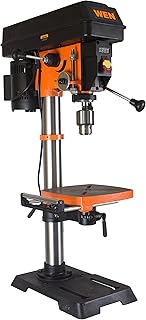
WEN 12-Inch Benchtop Drill Press (DP1263V)
The variable-speed dial is what earns this one the top spot for metal: you can dial down into the low hundreds of RPM without swapping belts, which means you actually will slow down for that 1/2″ hole instead of talking yourself into full speed. The 6.2-amp motor, cast iron table, and 3.2″ quill travel give it enough authority for structural flat bar, and the laser plus LED light are genuinely useful when you are lining up a center-punched mark on dark steel.
VEVOR Mag Drill Press with 11-Piece Bit Set
A magnetic drill solves the problem no benchtop press can: drilling a hole in something already welded, bolted, or too large to lift. With 2,922 lbf of magnetic hold and 1300W behind a 1.57″ boring capacity, this one locks onto a steel frame and drills through like a bolted-down machine, and the included bits mean you are cutting the same afternoon it lands.
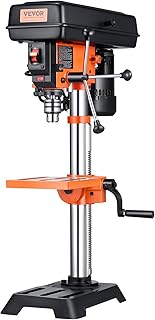
VEVOR Benchtop Drill Press, 10-Inch Swing
Solid middle ground for a mixed wood-and-metal shop — cast iron frame, five belt-driven speeds, and a table that tilts 0–45° for angled bolt holes in mitered steel. The 3.2-amp motor is honest about its limits, so keep the bits sharp and let it work at the slow end for anything past 3/8″.
WEN 8-Inch 5-Speed Cast Iron Benchtop Drill Press (4206T)
Small footprint, real cast iron, and a low speed setting that handles thin steel and aluminum brackets without complaint. It is not the press for 1/2″ holes in structural plate, but for shelf hardware, mounting tabs, and pilot holes it is more machine than the price suggests.
Upgrade Mini Benchtop Drill Press, 340W
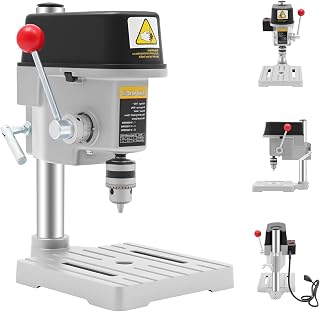
Built for precision at small scale — jewelry blanks, thin brass, tiny pilot holes in aluminum trim — where a full-size press is clumsy and overpowered. Three speeds and a 340W motor keep it in the sub-1/8″ range, so treat it as a companion tool rather than your only press.
Frequently Asked Questions
What speed should I use for drilling steel?
Slower than you think. Mild steel with a 1/4″ HSS bit runs around 900–1,000 RPM; step up to 1/2″ and you want 400–500. Stainless drops lower still. Use cutting fluid, apply firm steady pressure, and watch for a continuous curling chip — that is the sign you have it right.
Can a wood drill press handle metal?
Sometimes, within limits. If its slowest speed is under about 600 RPM and the frame is cast iron, you can drill small holes in mild steel and aluminum. Presses that bottom out near 700+ RPM will overheat bits and glaze the hole.
Do I need a mag drill for furniture work?
Only if you fabricate. Once a steel table base is welded up, it will not fit under a column, and a magnetic drill lets you add mounting holes after the fact. For loose stock cut to size beforehand, a benchtop press is easier and cheaper.
What bits should I use?
Cobalt (M35 or M42) for steel and stainless, since it holds an edge at heat far better than basic HSS. Always center-punch first — a bit that wanders on hard material will spoil the layout and can grab. For holes over 1/2″, step-drill rather than going straight to size.
Final Thoughts
For most home shops mixing wood furniture with steel components, the WEN 12-Inch Variable Speed (DP1263V) is the one to buy — the stepless speed control makes proper metal drilling effortless rather than a belt-swapping chore. If you weld your own bases and need to drill assembled frames, add the VEVOR Mag Drill with the 11-piece bit set. And if your metalwork is limited to brackets and hardware, the WEN 4206T gives you honest cast iron accuracy without surrendering half your bench.