Key takeaways
- Tooth count: 80T handles most furniture crosscuts cleanly; 100T is where you go for veneered plywood, melamine, and moldings where any tearout is visible in the finished piece. Above 100T on a 12-inch blade you’re mostly buying heat, not smoothness.
- Grind geometry: ATB (alternate top bevel) slices wood fibers on both faces of the kerf, which is exactly what you want for crosscutting. High-ATB angles cut cleaner but dull faster — a fair trade on a dedicated finish blade.
- Plate quality and kerf: A tensioned, laser-cut plate with expansion slots resists warping under load. Thin-kerf blades ease strain on smaller motors, though a full-kerf plate stays truer through a tall stack of hardwood.
- Carbide grade: Micrograin C4 carbide holds its edge substantially longer than generic tips and survives more resharpenings. Look at tip thickness too, since thicker shoulders mean more life left in the blade.
- Arbor and hook angle: Confirm the 1-inch arbor matches your saw, and favor a low or negative hook angle for miter work. Aggressive positive hook grabs stock and lifts the workpiece off the fence.
What's inside
You know the cut I’m talking about. You line up a piece of pre-finished poplar for a face frame, drop the saw, and the edge that comes back looks like it lost a fight with a cheese grater. Splintered veneer on the underside, fuzz along the top shoulder, and a joint line that shows daylight no matter how much you clamp it. Nine times out of ten the saw isn’t the culprit — it’s the 24-tooth framing blade that shipped in the box, still spinning away at furniture work it was never designed to touch.
This guide covers twelve 12-inch blades built specifically for finish work: high tooth counts, ATB grinds, and carbide that holds an edge long enough to matter across a full project. I’ve grouped them by what they actually do well, so you can match a blade to hardwood crosscuts, sheet goods, or delicate trim without guessing. Below you’ll find the picks, followed by the specs that genuinely affect cut quality and the ones marketing departments like to inflate.
As an Amazon Associate we earn from qualifying purchases.



🛒 Best Price Today on Amazon
Prime members get fast, free shipping on everything above, plus member-only deals. New members get a 30-day free trial — cancel anytime.
How to Choose a 12 Miter Saw Blade For Fine Cuts (2026)
- Tooth count: 80T handles most furniture crosscuts cleanly; 100T is where you go for veneered plywood, melamine, and moldings where any tearout is visible in the finished piece. Above 100T on a 12-inch blade you’re mostly buying heat, not smoothness.
- Grind geometry: ATB (alternate top bevel) slices wood fibers on both faces of the kerf, which is exactly what you want for crosscutting. High-ATB angles cut cleaner but dull faster — a fair trade on a dedicated finish blade.
- Plate quality and kerf: A tensioned, laser-cut plate with expansion slots resists warping under load. Thin-kerf blades ease strain on smaller motors, though a full-kerf plate stays truer through a tall stack of hardwood.
- Carbide grade: Micrograin C4 carbide holds its edge substantially longer than generic tips and survives more resharpenings. Look at tip thickness too, since thicker shoulders mean more life left in the blade.
- Arbor and hook angle: Confirm the 1-inch arbor matches your saw, and favor a low or negative hook angle for miter work. Aggressive positive hook grabs stock and lifts the workpiece off the fence.
The Best 12 Miter Saw Blade For Fine Cuts (2026)s Reviewed
ANGELSWORD 12″ 100T Ultra Fine Finish, 2 Pack
Two 100-tooth blades at roughly the cost of one premium unit makes this the sensible pick for anyone who cuts enough MDF and plywood to dull a blade mid-project. Edge retention doesn’t rival a top-shelf blade, but having a fresh one on the shelf beats limping along with a tired one.
DEWALT DWA112100 100 Tooth Fine Finish
The benchmark most finish blades get measured against, and it earns that with tight tolerance grinding that leaves hardwood end grain nearly ready for finish straight off the saw. Runout is minimal, so miters close tight without shimming or fussing.
WEN BL1280 12″ 80-Tooth
Eighty teeth is the sweet spot for solid wood — enough for a glue-ready surface while clearing chips fast enough to avoid scorching maple or cherry. A smart everyday blade if you spend more time on hardwood than sheet goods.
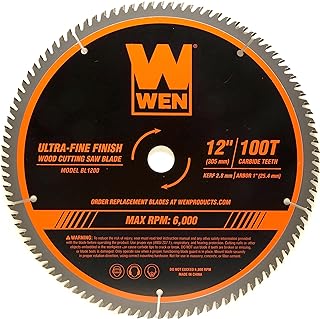
WEN BL1200 12″ 100-Tooth Carbide-Tipped
The BL1280’s finer sibling, aimed squarely at veneered panels and painted trim where surface tearout is unforgivable. Feed it slowly and it produces glass-smooth edges; rush it and you’ll get burn marks on dense stock.
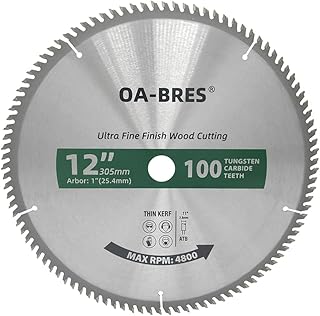
12″ 100-Tooth ATB TCT with 1-Inch Arbor
A no-frills TCT blade with proper ATB geometry and a standard 1-inch arbor that fits nearly every 12-inch miter saw on the market. Solid value for occasional finish cuts, though heavy production users will want thicker carbide.
Frequently Asked Questions
Does a higher tooth count always cut cleaner?
Only up to a point. More teeth means smaller gullets and less chip clearance, so pushing a 100T blade through thick hardwood traps dust and burns the cut. Match tooth count to material thickness rather than defaulting to the highest number.
Can I use a fine-finish miter blade on my table saw?
For crosscutting on a sled, yes — several of these are rated for both. For ripping, no. High tooth counts bog down and overheat in a rip cut, and that’s a genuine kickback risk.
How often should these blades be sharpened?
Watch the cut, not the calendar. Increased feed pressure, burning, or fuzz on the exit side means it’s time. Quality carbide typically survives three to five professional resharpenings.
Do I still need a zero-clearance insert?
It helps considerably. Even a 100-tooth blade produces some underside tearout when fibers have nothing supporting them, and backing the cut with a sacrificial fence or insert closes that gap.
Final Thoughts
For furniture work where the cut becomes a visible joint, the DEWALT DWA112100 remains the most consistent performer in this group. If you’d rather spread your budget across replacements, the ANGELSWORD 100T two-pack covers a lot of sheet goods for the money, while the WEN BL1280 at 80 teeth is the blade I’d reach for on solid hardwood crosscuts.