Key takeaways
- Tooth count and what you’re cutting: Match the count to the job. 40 to 60 teeth handles framing lumber, deck boards, and general crosscuts without bogging your motor. 80 teeth is the sweet spot for hardwood trim and cabinet parts. 100 teeth is for veneered plywood, melamine, and any cut that goes straight to finish with no sanding. Running a 100-tooth blade through wet 4x4s just clogs the gullets and burns the wood.
- ATB grind versus TCG: Alternate top bevel teeth act like tiny knives that slice wood fibers cleanly, which is exactly what you want for crosscutting. Triple-chip grinds are built for laminate and non-ferrous metal and leave a rougher edge in solid wood. For furniture work, ATB or a Hi-ATB variant is the right call every time.
- Arbor bore and plate thickness: Nearly every 12-inch miter saw uses a 1-inch arbor, so confirm that before ordering. Pay attention to kerf too. Thin-kerf blades ask less of the motor and waste less material, but a stiffer full-kerf plate with laser-cut expansion slots tracks straighter through 4-inch crown molding.
- Carbide grade and tooth geometry: Not all tungsten carbide is equal. Denser, finer-grain carbide holds a keen edge through more linear feet and survives more resharpenings. Look for teeth brazed with visible, uniform shoulders and a negative or low hook angle, which prevents the blade from self-feeding and climbing on a sliding miter saw.
- Anti-vibration and coatings: Expansion slots, copper plugs, and laser-cut stabilizer vents keep the plate from resonating and howling, which shows up directly as a smoother cut surface. A non-stick coating reduces pitch buildup and heat, and heat is what warps plates and dulls carbide prematurely.
The blade that came bolted to your miter saw was chosen by an accountant, not a woodworker. It’s usually a 24- or 32-tooth general-purpose disc that leaves a fuzzy, chipped edge on plywood and burnished scorch marks on hard maple. If you’ve ever cut a picture frame miter and watched the joint gap open up under clamping pressure, or spent an hour sanding tearout off poplar baseboard that should have come off the saw ready to prime, the problem probably isn’t your technique or your fence. It’s the 90 cents of carbide spinning at 4,000 RPM.
Swapping in a proper finish blade is the cheapest upgrade in the shop. A good 80- or 100-tooth blade turns a rough construction saw into something you can trust on face frames, mitered casework, and hardwood trim. Below are six 12-inch blades worth bolting to a real saw, plus a practical rundown of what tooth count, hook angle, and plate quality actually do to your cut, and where it makes sense to save money versus where it doesn’t.
Our top picks


As an Amazon Associate we earn from qualifying purchases at no extra cost to you. Ratings are shown as listed on Amazon.
🛒 Best Price Today on Amazon
Prime members get fast, free shipping on everything above, plus member-only deals. New members get a 30-day free trial — cancel anytime.
How to Choose a 12-Inch Miter Saw Blades (2026)
- Tooth count and what you’re cutting: Match the count to the job. 40 to 60 teeth handles framing lumber, deck boards, and general crosscuts without bogging your motor. 80 teeth is the sweet spot for hardwood trim and cabinet parts. 100 teeth is for veneered plywood, melamine, and any cut that goes straight to finish with no sanding. Running a 100-tooth blade through wet 4x4s just clogs the gullets and burns the wood.
- ATB grind versus TCG: Alternate top bevel teeth act like tiny knives that slice wood fibers cleanly, which is exactly what you want for crosscutting. Triple-chip grinds are built for laminate and non-ferrous metal and leave a rougher edge in solid wood. For furniture work, ATB or a Hi-ATB variant is the right call every time.
- Arbor bore and plate thickness: Nearly every 12-inch miter saw uses a 1-inch arbor, so confirm that before ordering. Pay attention to kerf too. Thin-kerf blades ask less of the motor and waste less material, but a stiffer full-kerf plate with laser-cut expansion slots tracks straighter through 4-inch crown molding.
- Carbide grade and tooth geometry: Not all tungsten carbide is equal. Denser, finer-grain carbide holds a keen edge through more linear feet and survives more resharpenings. Look for teeth brazed with visible, uniform shoulders and a negative or low hook angle, which prevents the blade from self-feeding and climbing on a sliding miter saw.
- Anti-vibration and coatings: Expansion slots, copper plugs, and laser-cut stabilizer vents keep the plate from resonating and howling, which shows up directly as a smoother cut surface. A non-stick coating reduces pitch buildup and heat, and heat is what warps plates and dulls carbide prematurely.
The Best 12-Inch Miter Saw Blades (2026)s Reviewed
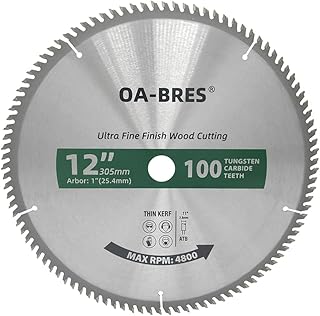
100-Tooth ATB TCT Ultra Fine Finish Blade
A straightforward value play: full 100-tooth ATB carbide geometry with a 1-inch arbor, aimed squarely at people who want glass-smooth crosscuts without spending premium money. It won’t hold an edge as long as top-tier carbide, but for occasional finish work and doubling as a table saw blade, it earns its spot.
DEWALT DWA112100 100-Tooth Fine Finish
DEWALT’s 100-tooth finish blade is the safe recommendation for anyone building furniture from veneered sheet goods, leaving edges clean enough to skip sanding before edge banding. The tungsten carbide teeth are well brazed and the plate stays quiet through wide crosscuts, though feed rate matters more with high tooth counts, so let it cut rather than pushing.
Diablo D1280X 80-Tooth Fine Finish
If I had to keep one blade permanently mounted, this is it. The 80-tooth count with Hi-Density carbide and Freud’s anti-vibration plate hits the ideal compromise between cut quality and cutting speed, handling hard maple, oak, and cherry without the burning you get from denser blades pushed too slowly.
DEWALT DWA112CMB 40T & 60T Combo Pack
The smartest first purchase for a new saw owner, since it covers the two tooth counts you’ll reach for most: 40-tooth for framing and rough stock breakdown, 60-tooth for trim and general crosscuts. Buying them together typically costs less than one premium finish blade.
FOXBC 100-Tooth Polished Finish
FOXBC has quietly built a following among hobbyists for delivering close-to-name-brand results at a friendlier price, and this 100-tooth blade cuts melamine and plywood with minimal chipout on the underside. Worth a look if you’re outfitting a shop and need multiple blades without a premium budget.
Frequently Asked Questions
Does more teeth always mean a better cut?
Only up to a point, and only for the right material. High tooth counts remove less material per tooth, which produces a smoother surface but generates more heat and demands slower feed rates. In thick hardwood, a 100-tooth blade pushed hard will burn the cut face while an 80-tooth blade sails through clean.
Can I use a 12-inch miter saw blade in a table saw?
Only if your table saw is rated for a 12-inch blade and the arbor and RPM specs match. Most cabinet saws take 10-inch blades, and mounting an oversized blade is genuinely dangerous. Always check the maximum blade diameter stamped on your saw before swapping.
Is a stainless steel blade better than a standard steel plate?
The plate material matters far less than the carbide teeth doing the cutting. Corrosion resistance is a nice bonus in a damp garage, but flatness, runout, and carbide quality determine how your cuts look. Judge blades on grind and plate stability, not plate alloy marketing.
When should I sharpen versus replace?
Quality carbide blades are worth resharpening two or three times, and a professional service costs a fraction of replacement. Watch for rising cut resistance, burning, or increased tearout as your signals. Replace when teeth are chipped, missing, or ground down past usable carbide, or if the plate has taken a warp.
Final Thoughts
For most furniture makers, the Diablo D1280X is the blade to buy first: 80 teeth is versatile enough for hardwood, plywood, and trim, and the plate stays composed through long crosscuts. If your work leans heavily on veneered sheet goods and melamine where any chipout is unacceptable, add the DEWALT DWA112100 for pure finish duty. And if you’re starting from a bare saw with a mix of construction and furniture work ahead, the DEWALT DWA112CMB combo pack covers the practical middle ground for less than most single premium blades cost.