Key takeaways
- Tooth count: Use roughly 24–40 teeth for fast framing cuts, 50–60 teeth for versatile crosscuts, and 80 or more teeth for clean furniture and trim work.
- Blade diameter: Match the blade diameter specified for your miter saw. A 10-inch blade is not a substitute for a 12-inch blade, even if the arbor appears compatible.
- Arbor size: Confirm the center-hole diameter before ordering. Many 10-inch saws use a 5/8-inch arbor, while larger saws may use a different specification.
- Kerf and power: A thin-kerf blade removes less wood and can suit compact saws, while a standard-kerf blade may feel sturdier on powerful machines and thicker stock.
- Cut material: Most of these blades are intended for wood. Check the manufacturer’s guidance before cutting plywood, laminates, pressure-treated lumber, or materials containing nails.
Choosing a miter-saw blade is less about buying the blade with the highest tooth count and more about matching the blade to the work. A rough framing blade can make quick cuts, but it may leave a ragged edge on furniture parts; an ultra-fine blade can produce a beautiful finish, yet cut more slowly and cost more when used on construction lumber.
This guide focuses on practical shop use: tooth count, kerf, material compatibility, arbor size, and the finish you can realistically expect. The picks below cover framing, general woodworking, trim, shelving, and furniture projects so you can choose a blade that fits your saw and your next cut list.
Our top picks


As an Amazon Associate we earn from qualifying purchases at no extra cost to you. Ratings are shown as listed on Amazon.
🛒 Best Price Today on Amazon
Prime members get fast, free shipping on everything above, plus member-only deals. New members get a 30-day free trial — cancel anytime.
How to Choose Saw Blades For Miter Saws (2026)
- Tooth count: Use roughly 24–40 teeth for fast framing cuts, 50–60 teeth for versatile crosscuts, and 80 or more teeth for clean furniture and trim work.
- Blade diameter: Match the blade diameter specified for your miter saw. A 10-inch blade is not a substitute for a 12-inch blade, even if the arbor appears compatible.
- Arbor size: Confirm the center-hole diameter before ordering. Many 10-inch saws use a 5/8-inch arbor, while larger saws may use a different specification.
- Kerf and power: A thin-kerf blade removes less wood and can suit compact saws, while a standard-kerf blade may feel sturdier on powerful machines and thicker stock.
- Cut material: Most of these blades are intended for wood. Check the manufacturer’s guidance before cutting plywood, laminates, pressure-treated lumber, or materials containing nails.
The Best Saw Blades For Miter Saws (2026) Reviewed
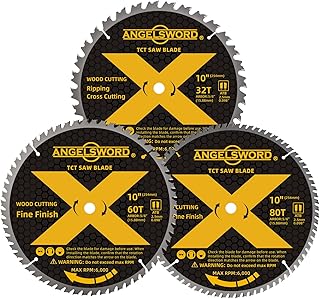
10-Inch 3-Pack with 32T, 60T, and 80T Blades
This three-blade set is a practical starter kit for a mixed-use workshop. The 32-tooth blade handles faster framing cuts, while the 60-tooth and 80-tooth options let you move toward cleaner edges for cabinetry, shelving, and furniture parts. It is especially useful if you would rather swap blades for each job than force one blade to do everything.
WEN BL1080 10-Inch 80-Tooth Blade
The WEN BL1080 is aimed at clean, detailed cuts in wood, making it a sensible choice for trim, face frames, and visible furniture components. Its 80-tooth layout favors finish quality over speed, so use a steady feed rate and avoid treating it like a demolition blade.
WEN BL1280 12-Inch 80-Tooth Blade
For a 12-inch miter saw, the WEN BL1280 provides a high-tooth-count option for fine woodworking and crosscutting. The larger diameter suits saws with greater cutting capacity, but buyers should verify both the blade size and arbor specification before ordering.
WEN BL1060 10-Inch 60-Tooth Blade
The BL1060 occupies the useful middle ground between a rough-cut blade and an ultra-fine finish blade. Its 60 teeth make it a good everyday option for dimensional lumber, plywood, and general furniture work when you want a clean cut without sacrificing too much cutting speed.
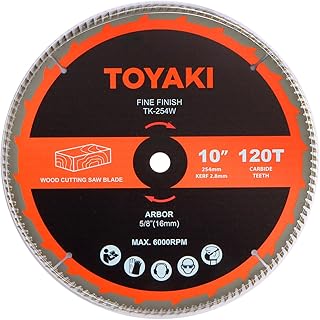
10-Inch 120-Tooth Fine-Finish Blade
A 120-tooth blade is designed for exceptionally clean, controlled cuts where edge quality matters more than speed. It can be a helpful choice for delicate trim and finished furniture parts, although the dense tooth pattern rewards a sharp blade, careful alignment, and a moderate feed rate.
Frequently Asked Questions
What tooth count is best for a miter saw?
For general woodworking, a 50- to 60-tooth blade is usually the most versatile starting point. Choose fewer teeth for fast rough cuts and more teeth when you need a smoother edge on trim or furniture components.
Can I use a table-saw blade on a miter saw?
Often, yes, if the blade diameter, arbor, speed rating, and intended material are compatible with your saw. Always follow the miter saw manufacturer’s requirements, and never install a blade that exceeds the saw’s rated size or speed.
Why does my new blade leave a rough cut?
Tooth count is only part of the equation. Check that the blade is installed in the correct direction, the workpiece is firmly supported, the saw is properly aligned, and the blade is appropriate for the material and cut direction.
How often should I replace a miter-saw blade?
Replace it when cuts become noticeably rough, burning appears despite a suitable feed rate, or the blade has damaged or missing teeth. A quality blade can often be cleaned and sharpened, but deep damage or excessive wear usually makes replacement the safer option.
Final Thoughts
For the broadest coverage, the 10-Inch 3-Pack is a strong workshop starter because it gives you rough, general-purpose, and fine-finish options. The WEN BL1060 is a dependable everyday choice, while the WEN BL1080 or 120-tooth blade makes more sense when clean furniture and trim cuts take priority.