The blade that came bundled with your miter saw was never meant to be the one you keep. Factory blades typically run 24 to 40 teeth with aggressive hook angles, which is fine for chopping deck framing but leaves splintered end grain on poplar, torn veneer on plywood, and burn marks on hard maple. If you’ve been sanding away tearout after every crosscut, the saw isn’t the problem. Swapping the blade is the single cheapest upgrade in the shop, and it changes what the tool is capable of overnight.
This guide walks through the blades worth putting on a 10-inch or 12-inch miter saw in 2026, from ultra-fine finish blades for face frames and picture molding to non-ferrous grinds for aluminum extrusion and multipacks that cover both rough and finish work. Every pick below is judged on tooth geometry, carbide quality, plate stability, and whether it actually earns its keep next to a stock blade.
Our top picks


As an Amazon Associate we earn from qualifying purchases at no extra cost to you.
🛒 Best Price Today on Amazon
Prime members get fast, free shipping on everything above, plus member-only deals. New members get a 30-day free trial — cancel anytime.
How to Choose a Saw Blade For Miter Saw (2026)
- Tooth count matched to the cut: 24–40 teeth rip fast and clear chips well for framing lumber. 60–80 teeth is the sweet spot for crosscutting hardwood and sheet goods. 100–120 teeth is finish-only territory, and pushing those blades through thick stock will overheat the carbide.
- Grind style: ATB (alternate top bevel) slices wood fibers cleanly and is the default for crosscutting. TCG (triple chip grind) has a flat raker tooth that shears rather than slices, which is what you want for aluminum, plastics, and laminate.
- Arbor size, no guessing: Nearly every 10-inch miter saw takes a 5/8-inch arbor; most 12-inch saws take 1-inch. Measure your existing blade before ordering, because a bushing-shimmed fit introduces runout you’ll see in every cut.
- Plate and expansion slots: Look for a laser-cut plate with anti-vibration slots and a tensioned body. A wobbly plate produces a wider kerf than the teeth suggest and a lot more noise. Thin-kerf blades reduce load on smaller motors but flex more on deep bevels.
- Carbide grade over tooth count marketing: A 60-tooth blade with dense micro-grain C4 carbide will outlast and outcut an 80-tooth blade with soft brazed tips. Check whether the blade can be professionally resharpened, which tells you a lot about tip thickness.
The Best Saw Blade For Miter Saw (2026)s Reviewed
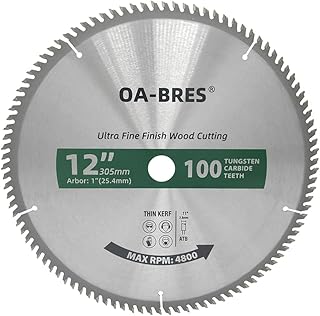
12-Inch 100-Tooth ATB Ultra Fine Finish Blade (1″ Arbor)
For 12-inch saws doing crown molding, casing, and hardwood trim, this 100-tooth ATB grind leaves an edge that goes straight to finish with a light scuff. Feed it slowly and let the tooth count do the work; rushing thick stock with this many teeth is how you get burn on cherry and maple.
10-Inch TCG 120-Tooth Aluminum Blade
The triple chip grind and near-zero hook angle make this the blade to grab for aluminum angle, extrusion, and thick PVC trim, where an ATB blade would grab and climb. Clamp your workpiece properly, use a wax stick lubricant, and it produces a shockingly clean chop for a fraction of the price of a dedicated metal saw.
KENDO 10-Inch 2-Pack, 40T + 60T
A smart starter pairing that acknowledges no single blade does everything: the 40-tooth handles framing lumber and rough breakdown, while the 60-tooth handles plywood, MDF, and laminate without shredding the top veneer. Best value here is for anyone building shop furniture and case goods from sheet stock.
10-Inch 80-Tooth Carbide Fine Finish Blade (Red)
Rated to 7000 RPM with a straightforward tungsten carbide ATB grind, this is the do-most blade for a 10-inch miter saw doing furniture-scale work. It crosscuts hardwood cleanly, tracks well on 45-degree miters, and holds a usable edge far longer than any stock blade.
10-Inch 3-Pack: 32T, 60T, 80T
The most complete single purchase on this list, covering framing, general crosscutting, and ultra-fine finish in one box. Practical advice: keep the 80-tooth reserved for final cuts on visible parts and use the 32-tooth for rough sizing so you’re not dulling your best blade on construction lumber.
Frequently Asked Questions
How many teeth do I actually need for furniture work?
Eighty teeth on a 10-inch blade covers the vast majority of furniture crosscuts in hardwood and plywood. Go higher only if you’re cutting delicate molding or veneered panels where any tearout is unacceptable.
Why does my blade burn the wood?
Usually a dull blade, too slow a feed rate, or too many teeth for the thickness of stock you’re cutting. Pitch buildup is another common culprit; clean the blade with a resin remover and the burning often disappears entirely.
Can I use a table saw blade on a miter saw?
Often yes, if the diameter and arbor match, but check the hook angle. Positive-hook rip blades designed for table saws can self-feed aggressively on a miter saw, pulling the head down through the cut. Blades marked for miter saws use a low or negative hook for that reason.
When should I replace versus sharpen?
Quality carbide blades are worth resharpening two or three times before the tips get too thin. Budget blades and thin-kerf finish blades are generally more economical to replace outright.
Final Thoughts
For most home furniture builds on a 10-inch saw, the 80-tooth carbide fine finish blade is the one to install and leave on, with the 3-pack of 32T/60T/80T making more sense if you want dedicated blades for framing and finish work rather than compromising with one. If you’re running a 12-inch saw for trim and molding, the 100-tooth ATB blade delivers the cleanest edge of anything here, and the TCG 120-tooth is worth keeping on the shelf the moment aluminum enters your project list.