Key takeaways
- Read load ratings per shelf, not per unit: A “5000LBS” label almost always describes the total across all tiers with evenly distributed weight. Divide by the tier count for your realistic working number, then leave headroom for concentrated loads like engine blocks or bagged concrete.
- One-piece uprights beat stacked sections: Frames assembled from short segments joined mid-span introduce flex points. Continuous posts running floor to top transfer load straight down and stay square under lateral nudges from a passing car door.
- Match depth to your bay, not your ambition: 24″ deep shelves hold pallets of paint and full-size totes but eat serious floor space. In a single-car garage, 18″ often keeps the walkway usable while still handling most storage bins.
- Look for side braces and supporting ribs: Diagonal side bracing resists racking; underdeck ribs stop the shelf itself from bowing. Count them. Sixteen ribs across four tiers means real support, not decorative stamping.
- Plan for humidity and salt: Powder-coated or galvanized finishes matter in any garage that sees winter vehicles or coastal air. Bare steel edges will bloom rust within a season near a leaky slab.
Anyone who has stacked totes four high against a garage wall knows how that story ends: the bin you need is always at the bottom, and the whole tower leans a little more every month. Consumer-grade wire racks make it worse. The particleboard decks bow under a car battery, the poles wobble when you slide out a toolbox, and the load ratings printed on the box quietly assume weight is distributed perfectly across all four shelves. Real garages don’t work that way. You set a 90-pound miter saw in one corner and hope for the best.
This guide focuses on shelving built to industrial tolerances — welded or boltless steel frames, one-piece uprights, and decks rated in the thousands of pounds rather than the hundreds. I’ve broken down what those load numbers actually mean, which construction details predict long-term stability, and how depth and height interact with a standard garage bay. Below are six units worth considering in 2026, plus the specs that separate a rack you’ll load once from one you’ll still be loading in a decade.
Our top picks


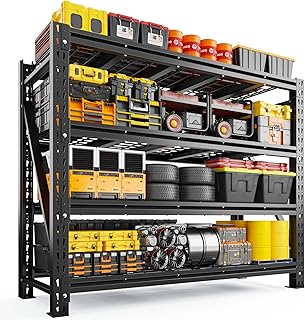


As an Amazon Associate we earn from qualifying purchases at no extra cost to you. Ratings are shown as listed on Amazon.
🛒 Best Price Today on Amazon
Prime members get fast, free shipping on everything above, plus member-only deals. New members get a 30-day free trial — cancel anytime.
How to Choose a Heavy Duty Garage Shelving (2026)
- Read load ratings per shelf, not per unit: A “5000LBS” label almost always describes the total across all tiers with evenly distributed weight. Divide by the tier count for your realistic working number, then leave headroom for concentrated loads like engine blocks or bagged concrete.
- One-piece uprights beat stacked sections: Frames assembled from short segments joined mid-span introduce flex points. Continuous posts running floor to top transfer load straight down and stay square under lateral nudges from a passing car door.
- Match depth to your bay, not your ambition: 24″ deep shelves hold pallets of paint and full-size totes but eat serious floor space. In a single-car garage, 18″ often keeps the walkway usable while still handling most storage bins.
- Look for side braces and supporting ribs: Diagonal side bracing resists racking; underdeck ribs stop the shelf itself from bowing. Count them. Sixteen ribs across four tiers means real support, not decorative stamping.
- Plan for humidity and salt: Powder-coated or galvanized finishes matter in any garage that sees winter vehicles or coastal air. Bare steel edges will bloom rust within a season near a leaky slab.
The Best Heavy Duty Garage Shelving (2026)s Reviewed
Bepatio 8000LB 4-Tier Steel Rack, 77″ W
At 77″ wide and 24″ deep with an 8000-pound total rating, this is the closest thing on the list to genuine warehouse pallet racking. The extra 6″ of width over most competitors means fewer units to cover a long wall, and the adjustable tiers accommodate everything from low-clearance tool chests to tall shop-vac setups.
Romorgniz 5000LB Steel Rack, 4-Tier
The construction details here are the selling point: one-piece uprights, dedicated side braces, and 16 supporting ribs under the decks. That combination is what keeps a loaded rack from developing the slow sideways lean that plagues cheaper boltless designs, and the rust-resistant finish holds up in unheated spaces.
71.3″ W 5000LB Metal Storage Shelves, 4 Tier
A well-proportioned workhorse at 71.3″ x 24″ x 70″ — tall enough to use vertical space without needing a ladder for the top tier. The black powder coat and adjustable shelf heights make it equally at home in a finished basement or a working shop.
RAVIGIN 5000LB Garage Shelving, 71″ W
Nearly identical footprint to the unit above, with adjustable tiers and a clean black finish. Worth a look if you want a straightforward four-tier layout and value simple assembly over extra features.
REIBII 3200LB 5-Tier Wire Shelving, 55.5″ W
The narrow-and-deep alternative: 55.5″ wide, 18″ deep, and five tiers instead of four. That extra shelf plus the shallower depth makes it the smart pick for pantries, basements, and single-car garages where floor space is tight but you still need real capacity.
Frequently Asked Questions
Do I need to anchor these to the wall?
Not structurally, if the unit is properly assembled and loaded heavy-on-the-bottom. That said, anchoring is cheap insurance in earthquake zones or any home with kids who might climb. Most units include anchor holes in the top rear rail.
Can these shelves hold weight in one spot, or does it need to be spread out?
Published ratings assume distributed load. For point loads — a floor jack, a car battery, a compressor — position the item directly over an upright rather than mid-span, and stay well under the per-shelf figure.
How long does assembly actually take?
Boltless rivet-style racks typically go together in 30 to 60 minutes with a rubber mallet and no other tools. Bolted designs take longer but let you re-torque connections later.
Will bare concrete damage the posts?
Direct contact with a damp slab can wick moisture into the feet over time. Most units ship with plastic foot caps; if yours didn’t, a few dollars of rubber pads solves it permanently.
Final Thoughts
For most garages, the Bepatio 8000LB 77″ rack is the one to beat — the widest span and highest capacity here, which means less hardware and more usable wall. If build quality matters more than raw size, the Romorgniz 5000LB with its one-piece uprights and 16 ribs is the more thoughtfully engineered unit. And in a tight bay or basement, the REIBII 3200LB 5-tier at 18″ deep gets you a fifth shelf without stealing the walkway.