Key takeaways
- SCFM at 90 PSI: This single number decides what tools you can run. Brad and finish nailers sip air and are happy under 2 SCFM. Orbital sanders and spray guns are thirsty, often wanting 4 SCFM or more continuously, so match the compressor to your hungriest tool rather than your most-used one.
- Duty cycle: A 75% rating means the pump can run three-quarters of any given period. Lower-rated units need cool-down breaks, which is fine for intermittent nailing but frustrating mid-finish-coat when you cannot pause.
- Noise level: Standard direct-drive compressors land in the high 80s to low 90s dB. The ultra-quiet models running near 70 dB are genuinely conversational, which matters enormously in an attached garage or basement shop where the household is nearby.
- Oil-free versus lubricated: Oil-free pumps need no maintenance and never contaminate your air line with oil mist, a real concern before spraying finish. The tradeoff is more noise and a shorter service life under heavy daily use.
- Tank orientation and drain access: Vertical tanks free up floor space; horizontal ones are lower and easier to wheel over thresholds. Either way, find the drain before you buy. An automatic drain valve or an easy-access petcock is the difference between draining moisture weekly and forgetting until rust appears.
Anyone who has tried to shoot a full set of upholstery staples or spray a coat of lacquer on a dresser with a pancake compressor knows the problem: the motor kicks on, the pressure sags, and you stand there waiting. A 20-gallon tank is the sweet spot where that stalling mostly goes away. You get enough stored air to run a brad nailer through an entire cabinet carcass, keep a HVLP gun fed through a tabletop, or break loose stubborn hardware without the pump cycling every ten seconds. It is also still small enough to roll into a corner of a one-car garage when you are done.
This guide is written from the perspective of someone building furniture in a shared space, not running a body shop. We looked at real SCFM numbers at 90 PSI, duty cycle ratings, noise levels you can tolerate with a radio on, and whether the drain valve is somewhere you can actually reach. A few smaller compressors made the list too, because if your work is trim nailing and tire topping, spending more on a bigger tank buys you nothing but floor space.
Our top picks



As an Amazon Associate we earn from qualifying purchases at no extra cost to you. Ratings are shown as listed on Amazon.
🛒 Best Price Today on Amazon
Prime members get fast, free shipping on everything above, plus member-only deals. New members get a 30-day free trial — cancel anytime.
How to Choose a/an 20 Gallon Air Compressor (2026)
- SCFM at 90 PSI: This single number decides what tools you can run. Brad and finish nailers sip air and are happy under 2 SCFM. Orbital sanders and spray guns are thirsty, often wanting 4 SCFM or more continuously, so match the compressor to your hungriest tool rather than your most-used one.
- Duty cycle: A 75% rating means the pump can run three-quarters of any given period. Lower-rated units need cool-down breaks, which is fine for intermittent nailing but frustrating mid-finish-coat when you cannot pause.
- Noise level: Standard direct-drive compressors land in the high 80s to low 90s dB. The ultra-quiet models running near 70 dB are genuinely conversational, which matters enormously in an attached garage or basement shop where the household is nearby.
- Oil-free versus lubricated: Oil-free pumps need no maintenance and never contaminate your air line with oil mist, a real concern before spraying finish. The tradeoff is more noise and a shorter service life under heavy daily use.
- Tank orientation and drain access: Vertical tanks free up floor space; horizontal ones are lower and easier to wheel over thresholds. Either way, find the drain before you buy. An automatic drain valve or an easy-access petcock is the difference between draining moisture weekly and forgetting until rust appears.
The Best 20 Gallon Air Compressor (2026)s Reviewed
Klutch 20-Gallon Air Compressor, 2 HP
This is the well-rounded shop workhorse of the group: 4.2 SCFM at 90 PSI and a 175 PSI max mean you have real reserve for sanders and impact tools, and the 75% duty cycle keeps it working when you are on a deadline. The vertical footprint and large wheels are what sell it for a crowded garage, and the tank drain sits where you can reach it without lying on the concrete.
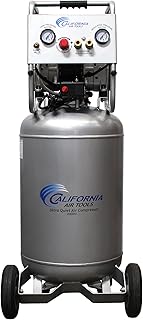
California Air Tools 20020AD Ultra Quiet
At roughly 70 dB, this one changes how you work. You can talk over it, leave the shop door open without irritating neighbors, and run it during a nap upstairs. The automatic drain valve handles moisture without you remembering, and the oil-free 2.0 HP pump keeps your air clean for finish work.
VEVOR 13-Gallon Air Compressor, 2HP
A smart compromise if 20 gallons is more than your space allows: 4.6 SCFM at 90 PSI is genuinely strong airflow, and 66 dB makes it the quietest unit here. The 125 PSI ceiling means slightly less stored energy per tank fill, so plan on marginally more cycling during sustained spraying.
Craftsman 2 Gallon Hot Dog
This is the grab-and-go unit for pin nailing a face frame or airing up a bike tire, not for anything continuous. At 0.5 CFM it will not feed a sander, but it weighs almost nothing and lives on a shelf between projects.
Ironton 3-Gallon Pancake
The pancake tank is stable on a sawhorse and the 0.3 HP oil-free pump asks nothing of you maintenance-wise. Treat it as a dedicated brad nailer companion and it will serve for years; ask more and it will disappoint.
Frequently Asked Questions
Can a 20-gallon compressor run a spray gun?
Yes, for furniture-scale work. Conventional HVLP guns want 4 SCFM or better at 90 PSI sustained, so the higher-output units here are the ones to look at. For larger panels, use an LVLP gun to reduce demand.
Do I need a 240V outlet?
Not for any of these. All run on standard 120V household power. Just give the compressor its own 15 or 20 amp circuit if you can, since startup surge on a shared circuit trips breakers.
How often should I drain the tank?
After every session in humid weather, weekly at minimum otherwise. Condensed water pools at the bottom and quietly corrodes the tank from inside, which is why automatic drain valves are worth paying for.
Will a 20-gallon tank run an air sander?
Intermittently, yes. Orbital sanders are among the thirstiest tools, so expect the pump to run nearly continuously. This is where the 75% duty cycle rating earns its keep.
Final Thoughts
For most furniture makers, the Klutch 20-Gallon is the right buy: honest airflow, a duty cycle that survives real projects, and a footprint that tucks away. If your shop shares walls with living space, the California Air Tools 20020AD is worth the premium for its 70 dB operation alone, and the VEVOR 13-Gallon covers you if floor space is tighter than your ambitions.