Key takeaways
- Measure your exact loop length: Band saws are unforgiving here. Check your manual or measure your current blade, because a 93″ blade will not stretch onto a 93-1/2″ machine. Portable saws run shorter loops, commonly 32-7/8″ or 44-7/8″ depending on the tool.
- Match TPI to material thickness: The old rule holds up: keep at least three teeth engaged in the cut at all times. Thick lumber wants 3 to 4 TPI so gullets can clear sawdust; thin-wall tubing and conduit need 14 to 18 TPI or the teeth will strip.
- Pick width by cut type: Wide blades (3/4″ and up) track straight and resist deflection for resawing. Narrow blades (1/4″ to 3/8″) turn tighter radii for curves and scrollwork. A 1/2″ blade splits the difference and covers most general work.
- Carbon steel versus bi-metal: Carbon steel is cheap, flexible, and fine for wood. Bi-metal blades weld high-speed-steel teeth to a spring-steel back, surviving heat and impact that would round over carbon teeth in minutes. Any metal cutting means bi-metal.
- Buy multipacks and rotate: Blades are consumables. Having a fresh one on the shelf means you swap the moment cut quality slips instead of forcing a tired blade and burning your workpiece.
A band saw is only as good as the strip of steel running through it. I learned that the hard way after wrestling with a factory blade that came with my 14-inch saw, wondering why every resaw cut wandered like a drunk uncle at a wedding. The frustration most folks hit is simple: they blame the machine, spend a weekend tuning guides and tensioning wheels, then discover the real culprit was a dull, wrong-pitch blade that cost less than a pizza. Blade selection is the single cheapest upgrade in the shop, and also the one most people get backwards.
The catch is that “band saw blade” covers wildly different tools. A 4 TPI hook-tooth blade meant for slicing walnut into veneer has nothing in common with a 14 TPI bi-metal blade built to chew through black pipe on a jobsite. Below I’ve pulled together six blades I’ve either run personally or seen hold up in shops I trust, spanning portaband loops for metal work and full-size 93-inch bands for woodworking. I’ll break down what actually matters when picking one, then walk through each blade and where it earns its keep.
Our top picks



As an Amazon Associate we earn from qualifying purchases at no extra cost to you. Ratings are shown as listed on Amazon.
🛒 Best Price Today on Amazon
Prime members get fast, free shipping on everything above, plus member-only deals. New members get a 30-day free trial — cancel anytime.
How to Choose a Band Saw Blade (2026)
- Measure your exact loop length: Band saws are unforgiving here. Check your manual or measure your current blade, because a 93″ blade will not stretch onto a 93-1/2″ machine. Portable saws run shorter loops, commonly 32-7/8″ or 44-7/8″ depending on the tool.
- Match TPI to material thickness: The old rule holds up: keep at least three teeth engaged in the cut at all times. Thick lumber wants 3 to 4 TPI so gullets can clear sawdust; thin-wall tubing and conduit need 14 to 18 TPI or the teeth will strip.
- Pick width by cut type: Wide blades (3/4″ and up) track straight and resist deflection for resawing. Narrow blades (1/4″ to 3/8″) turn tighter radii for curves and scrollwork. A 1/2″ blade splits the difference and covers most general work.
- Carbon steel versus bi-metal: Carbon steel is cheap, flexible, and fine for wood. Bi-metal blades weld high-speed-steel teeth to a spring-steel back, surviving heat and impact that would round over carbon teeth in minutes. Any metal cutting means bi-metal.
- Buy multipacks and rotate: Blades are consumables. Having a fresh one on the shelf means you swap the moment cut quality slips instead of forcing a tired blade and burning your workpiece.
The Best Band Saw Blade (2026)s Reviewed
LENOX 44-7/8″ 14 TPI Portable Band Saw Blades (5-Pack)
These are the loops I keep in the truck box for the full-size portaband, and the 14 TPI grind hits the sweet spot for angle iron, unistrut, and 1/2″ black pipe without loading up. Buying five at a time means you never talk yourself into finishing a job on a blade that’s already gone shiny.
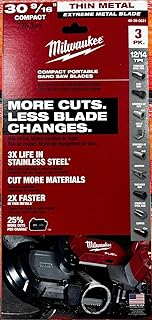
Milwaukee 48-39-0631 12/14 TPI Compact Blade (3-Pack)
Built for the compact portaband platform, the variable 12/14 pitch does a genuinely noticeable job of killing the chatter you get from a straight-pitch blade on thick stock. If you’re cutting solid rod or heavy-wall square tube overhead, the reduced vibration is worth the premium on its own.
Lenox Classic Tuff Tooth 93″ Bi-Metal, 18 TPI
A 3/4″-wide bi-metal band for benchtop metal cutting, and that width keeps the cut dead straight when you’re squaring up stock in a vise. The wavy-set 18 TPI configuration is tuned for thinner sections, so pair it with sheet, tubing, and light structural rather than heavy billet.
Timber Wolf 1/2″ x 93-1/2″ 4 TPI
This is my go-to woodworking blade and the one that finally made resawing pleasant on a mid-size saw. The low-tension silicon steel runs quieter than anything else at this price and the 4 TPI gullets clear pine and hardwood chips without the burn marks that plague finer blades.
DEWALT DW3983C 32-7/8″ 18 TPI (3-Pack)
The workhorse loop for compact portabands, and 18 TPI is the right call if most of your cutting is EMT, thin-wall tube, and threaded rod. Three to a pack at a reasonable price makes these easy to treat as disposable, which is exactly how you should treat metal-cutting blades.
Frequently Asked Questions
How tight should I tension a band saw blade?
Tight enough to stop flutter, not tight enough to stress the frame. Most cast-iron saws overtension by default. Bring it up until the blade deflects roughly 1/4″ under moderate side pressure between the guides, then test-cut a scrap and adjust from there.
Why does my blade drift to one side?
Usually uneven tooth wear from cutting a nail or a hard inclusion, which makes one side cut faster. It can also be guide misalignment or insufficient tension. If a fresh blade cuts true on the same setup, the old blade was the problem.
Can I cut metal with a wood blade?
No. Carbon steel teeth lose their temper almost instantly against steel, and the coarse pitch will hook and snap. Use a bi-metal blade with appropriate TPI, run it slow, and let the tool feed itself.
How long should a blade last?
Wildly variable, from an afternoon of hard steel cutting to months of occasional woodworking. Watch for the signs instead of counting hours: increased feed pressure, burning, squealing, or a cut that won’t stay square.
Final Thoughts
If you’re cutting wood, the Timber Wolf 1/2″ 4 TPI is the blade I’d hand a friend without hesitation, since it fixes resaw problems people usually blame on their saw. For metal on a full-size portaband, the LENOX 44-7/8″ 14 TPI five-pack is the reliable, restock-and-forget choice, while compact portaband owners get the smoothest cuts from the Milwaukee 48-39-0631 with its variable 12/14 pitch.